

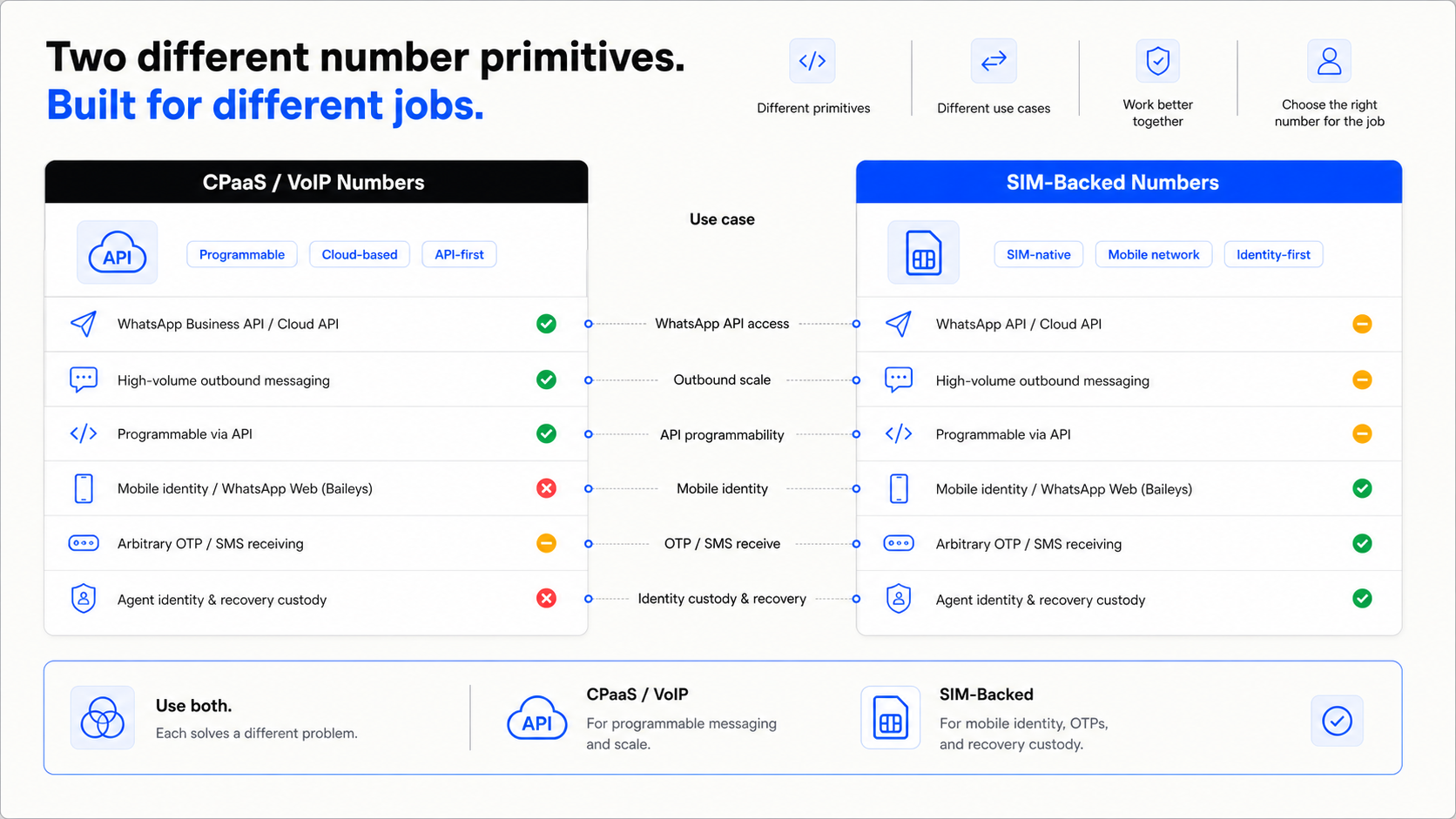
VoIP is useful, but it is not the same primitive
VoIP and CPaaS numbers are useful. They are often the right choice for programmable messaging, outbound SMS, generic inbound webhooks, call flows, support systems, and communication APIs.
They are not always the right primitive when the job is mobile-app identity, WhatsApp account setup, authorized OTP receiving, realistic agent workflows, or long-term phone-number custody.
Textrovault is not trying to replace Twilio, Vonage, Telnyx, or generic CPaaS. Textrovault’s wedge is narrower: dedicated SIM-based receive-only numbers for authorized WhatsApp and AI-agent workflows that need a real mobile-number identity, SMS receiving, dashboard access, API/webhooks, access controls, and logs.
What each number type is good for
A CPaaS or VoIP number is usually strongest when the workflow is about programmable communication. If you need an SMS API, webhook delivery, messaging orchestration, call routing, or standard communication infrastructure, CPaaS providers are already strong.
Twilio documents inbound message webhooks for phone numbers, and Vonage documents inbound SMS delivery to webhook endpoints. That proves programmable SMS receive is a real and useful pattern. The question is not whether CPaaS works. The question is whether CPaaS is the right number primitive for the workflow.
A SIM-backed number is different operationally. It is a mobile-number identity backed by a SIM, managed as an assigned asset, and used when the workflow needs a real mobile endpoint rather than only a virtual communication endpoint.
Where SIM-backed numbers matter
SIM-backed numbers matter when the number is part of an account identity rather than just a messaging route. That includes WhatsApp Web or Baileys-style account workflows, WhatsApp app registration, long-term reverification, authorized account setup, mobile-app testing, and agent workflows that need realistic SMS receiving.
For official WhatsApp Business API onboarding, the number also matters. Meta’s Cloud API documentation says the operator needs access to the phone number to receive a verification code during setup. It also explains that a number already registered with WhatsApp Messenger or the WhatsApp Business App may need deletion or migration before it can be added.
That is why the number should be chosen deliberately. If a workflow depends on recovery, reverification, app registration, client handoff, or long-term custody, the number is not just a route. It is part of the operating surface.
Choose the number type by workflow
Use this number type
| Use case | CPaaS / VoIP | SIM-backed |
|---|---|---|
| Outbound SMS API | Strong | Not Textrovault's wedge |
| WhatsApp Web / Baileys account | Weak / mixed | Strong |
| Official WhatsApp API onboarding | Mixed | Useful |
| Arbitrary OTP receiving | Mixed | Stronger |
| Agent identity custody | Weak | Strong |
Outbound SMS API
- CPaaS / VoIP
- Strong
- SIM-backed
- Not Textrovault's wedge
WhatsApp Web / Baileys account
- CPaaS / VoIP
- Weak / mixed
- SIM-backed
- Strong
Official WhatsApp API onboarding
- CPaaS / VoIP
- Mixed
- SIM-backed
- Useful
Arbitrary OTP receiving
- CPaaS / VoIP
- Mixed
- SIM-backed
- Stronger
Agent identity custody
- CPaaS / VoIP
- Weak
- SIM-backed
- Strong
The matrix is intentionally not universal. CPaaS is the right tool for many communication problems. SIM-backed is the right tool when the workflow needs mobile-number identity, SMS custody, or a realistic receive endpoint.
The mistake is using one number type everywhere. Use CPaaS when the job is programmable communication. Use a dedicated SIM-backed number when the number itself becomes account infrastructure.
Where Textrovault fits
Textrovault provides dedicated SIM-based numbers for authorized workflows. The service is focused on receiving SMS, not sending SMS. The number can be assigned to an agent, client, workflow, brand, or test environment, and messages can be accessed through a dashboard, API, or webhooks.
This makes Textrovault useful when an operator needs a number that is separate from a founder’s phone, employee phone, unmanaged spare SIM, or public inbox. The goal is not to replace CPaaS. The goal is to provide the missing SIM-backed receive layer for workflows where virtual numbers are the wrong substrate.
Textrovault is for authorized workflows only: accounts, systems, clients, brands, and processes the operator owns, manages, or is explicitly allowed to operate. It is not for spam, impersonation, unauthorized access, account farming, ban evasion, or bypassing platform rules.
If your WhatsApp or AI-agent workflow needs a dedicated SIM-backed number with SMS receiving, custody, access controls, and logs, apply for early access to Textrovault.