

A WhatsApp number is part of the agency deliverable
Agencies should not treat WhatsApp numbers casually. When an agency builds a WhatsApp agent, chatbot, CRM integration, shared inbox, support workflow, or automation for a client, the phone number becomes part of the system.
If that number belongs to a founder, employee, contractor, or unmanaged client account, the workflow may work on launch day but become fragile later. The agency may not control recovery. The client may not know who owns the number. Handoff may be unclear.
This article is for WhatsApp automation agencies, AI chatbot agencies, CRM implementers, Shopify and D2C consultants, and workflow automation builders who deploy WhatsApp systems for clients.
One client, one number is the safer default
The simplest agency rule is one client, one number. In some cases, it should be one brand, one number. In more complex cases, it should be one workflow or environment, one number.
The reason is ownership. A WhatsApp number identifies the account, receives verification or re-verification messages, anchors customer recognition, and becomes part of CRM, support, or automation infrastructure. When multiple clients or workflows share one number, responsibility becomes unclear.
This matters for both unofficial and official paths. If the workflow later moves toward the WhatsApp Business API, Meta’s Cloud API phone-number setup docs say the operator needs access to the number to receive the verification code, and numbers already registered with WhatsApp Messenger or the WhatsApp Business App may need to be deleted or moved before they can be added.
The common agency failure modes
The first failure mode is the founder number. The client starts WhatsApp on the founder’s phone and the agency builds around it. That may be convenient, but the workflow is now tied to a person’s private phone identity.
The second failure mode is the employee number. A salesperson or support person owns the number because they were the first person handling messages. When they leave, change roles, or lose access, the workflow inherits a recovery problem.
The third failure mode is agency-owned ambiguity. The agency buys or uses a spare number during implementation, but handoff terms are unclear. Six months later, nobody knows whether the number belongs to the agency, the client, the brand, or the workflow.
The fourth failure mode is no recovery path. The automation works, but nobody knows who receives re-verification messages, who can approve changes, or what happens if the number needs to be migrated.
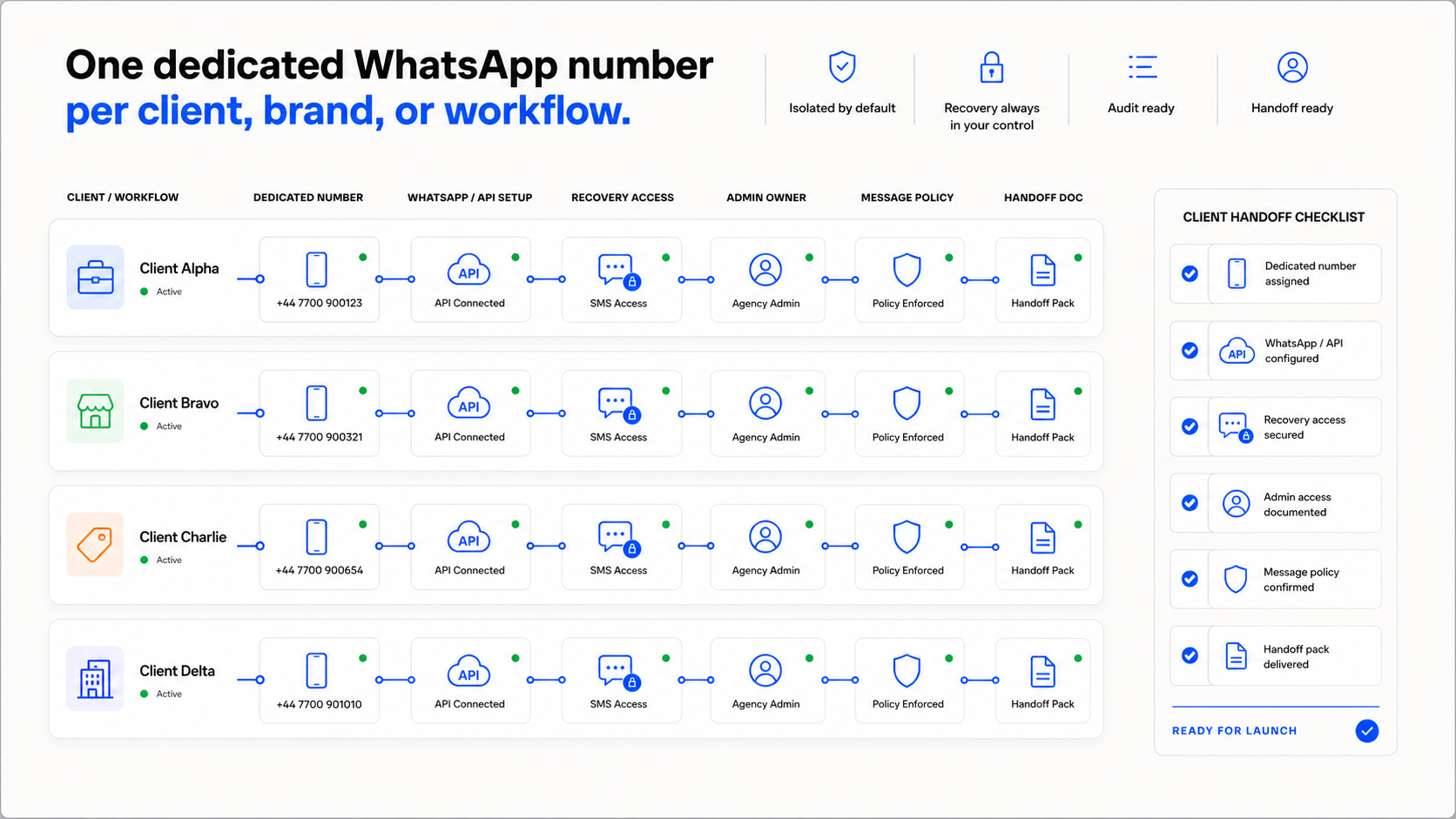
The agency handoff checklist
Agency handoff checklist
- 01Client
- 02Assigned number
- 03WhatsApp / API setup
- 04Recovery access
- 05Admin owner
- 06Message access policy
- 07Handoff documentation
This checklist is the minimum serious shape. If a WhatsApp workflow is delivered without an assigned number, recovery access, admin owner, message access policy, and handoff documentation, the agency has delivered automation without custody.
Agencies can also turn this into a cleaner commercial offer. Number setup can be sold as part of implementation, managed as an ongoing infrastructure add-on, or handled through a referral or commission model if the agency does not want to operate the number layer directly.
Where Textrovault fits
Textrovault provides dedicated SIM-based numbers that can be assigned to a client, brand, workflow, or environment. The number can receive SMS, be managed through a dashboard, connect through API or webhooks where needed, and keep access controls and logs around the workflow.
For an agency, this means the phone number can become a managed part of the delivery instead of a loose dependency. The client does not need to use a founder’s personal phone. The agency does not need to rely on an employee’s spare SIM. The handoff can include the number, recovery access, and custody record.
Textrovault does not replace WhatsApp Business API onboarding, BSPs, CRMs, helpdesks, WhatsApp policy compliance, or agency implementation work. It fills the phone-number layer that those workflows often assume but do not manage cleanly.
Textrovault is for authorized workflows only: accounts, systems, clients, brands, and processes the operator owns, manages, or is explicitly allowed to operate. It is not for spam, impersonation, unauthorized messaging, account farming, ban evasion, or bypassing platform rules.
If your agency needs dedicated SIM-based WhatsApp numbers for authorized client workflows, apply for early access to Textrovault.