

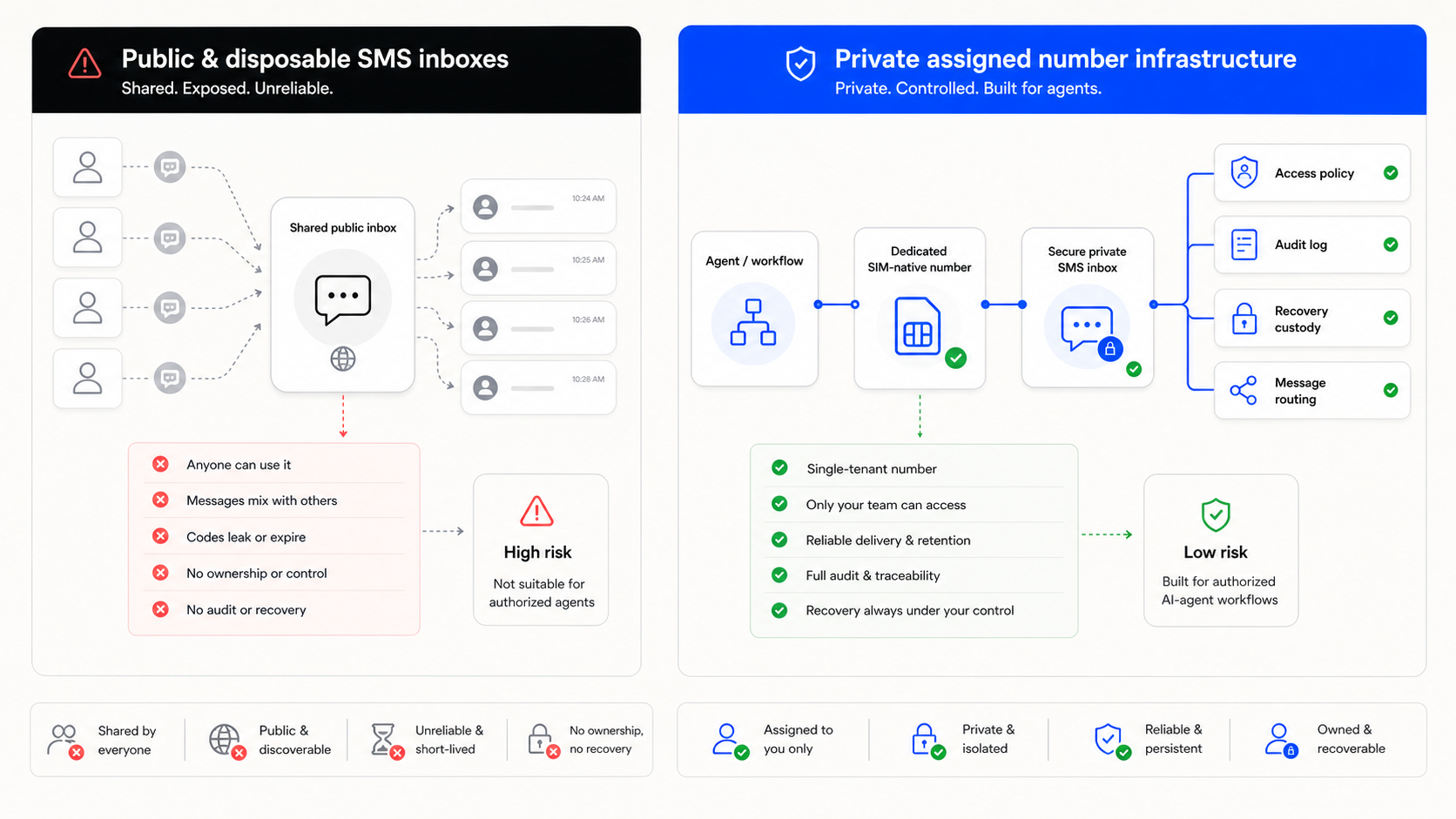
Public SMS inboxes are not serious infrastructure
Public SMS inboxes are easy to understand. A number is listed online, anyone can open the page, and messages sent to that number appear publicly. That may be useful for low-stakes privacy experiments. It is not a foundation for serious agent or business workflows.
The problem is simple: a public inbox is not private, not dedicated, not owned by the workflow, not recoverable, and not auditable. If an AI agent, client workflow, QA environment, or business process depends on SMS, the number cannot be a public object that anyone can view or reuse.
This article is for technical operators, AI automation agencies, QA teams, browser automation builders, and founders who need SMS receiving for authorized workflows and want to avoid the disposable-number category entirely.
The failure is ownership, not only privacy
The obvious problem with a public inbox is confidentiality. Messages are visible to whoever can access the public page. That alone disqualifies it for most business and agent workflows.
The deeper problem is ownership. The number does not belong to the agent, operator, client, environment, or business process. The workflow cannot rely on long-term access to the number. The operator cannot prove who received a message, who accessed it, why it was used, or whether recovery will work later.
A public inbox removes the human phone, but it also removes custody. It is not a controlled replacement for a personal number. It is an unowned shared surface.
Disposable numbers are the wrong category
Research on the disposable phone number ecosystem shows why this category should be treated carefully. The paper Your Code is 0000 monitored 17,141 disposable phone numbers across 29 public SMS gateways over 12 months and found that disposable numbers were used both for privacy and for abuse, including fraudulent account creation and bypassing security mechanisms.
That does not mean every user of a public inbox has bad intent. It means the category carries the wrong trust signal for serious infrastructure. If a business or agent workflow is legitimate, repeated, account-facing, or recovery-sensitive, it should not be built on a number type associated with public access and disposable use.
Cheap verification is not the same as operational SMS custody. Those are different jobs.
Public inboxes and assigned infrastructure are different products
Public inbox versus private assigned infrastructure
| Capability | Public / disposable inbox | Textrovault pattern |
|---|---|---|
| Privacy | Shared and visible | Private assigned inbox |
| Ownership | Unclear or shared | Assigned to workflow, client, agent, or environment |
| Recovery | Not reliable | Custody-controlled |
| Audit trail | Absent or unusable | Logged access |
| Authorized workflows | Wrong category | Policy-bound infrastructure |
Privacy
- Public / disposable inbox
- Shared and visible
- Textrovault pattern
- Private assigned inbox
Ownership
- Public / disposable inbox
- Unclear or shared
- Textrovault pattern
- Assigned to workflow, client, agent, or environment
Recovery
- Public / disposable inbox
- Not reliable
- Textrovault pattern
- Custody-controlled
Audit trail
- Public / disposable inbox
- Absent or unusable
- Textrovault pattern
- Logged access
Authorized workflows
- Public / disposable inbox
- Wrong category
- Textrovault pattern
- Policy-bound infrastructure
The table is the practical decision point. If the workflow is temporary, not private, and not important, a public inbox may technically work. If the workflow belongs to a business, client, agent, test environment, or production process, the number should be private and assigned.
A serious SMS receive layer should answer basic questions: who owns the number, who can view messages, who can recover access, what workflow the number belongs to, and what was logged when a message was used.
Where Textrovault fits
Textrovault is built for private, assigned, policy-bound SMS receiving. A number can be assigned to an agent, client, workflow, brand, or test environment. Messages can be received through a secure dashboard and exposed through API or webhooks where needed. Access controls and logs make the number manageable instead of disposable.
Textrovault is not a public inbox. It is not a free verification-number site. It is not for anonymous account creation, impersonation, spam, ban evasion, or bypassing platform rules. Those are the wrong use cases.
Textrovault is for authorized workflows only: accounts, systems, clients, brands, test environments, and processes the operator owns, manages, or is explicitly allowed to operate.
If your AI agent, WhatsApp workflow, QA test, or business process currently depends on a public SMS inbox or disposable number, replace the category. Use a private assigned number with custody, recovery access, and logs.
If that workflow needs SIM-based SMS receiving, apply for early access to Textrovault.