

SMS should become a software event
Programmatic SMS receiving means an SMS does not stay trapped on a phone. The message arrives on a SIM-backed number, enters a secure software system, and becomes available to authorized dashboards, APIs, webhooks, and workflows.
This is the useful primitive for AI agents and automation operators. The agent should not wait for a founder, employee, contractor, or client to read a message from a personal phone. The message should be assigned to the workflow and handled as an event.
Textrovault is focused on receive-only SMS infrastructure. It provides dedicated SIM-backed numbers, secure inbox access, API/webhooks, access controls, and logs for authorized workflows.
The pipeline is simple
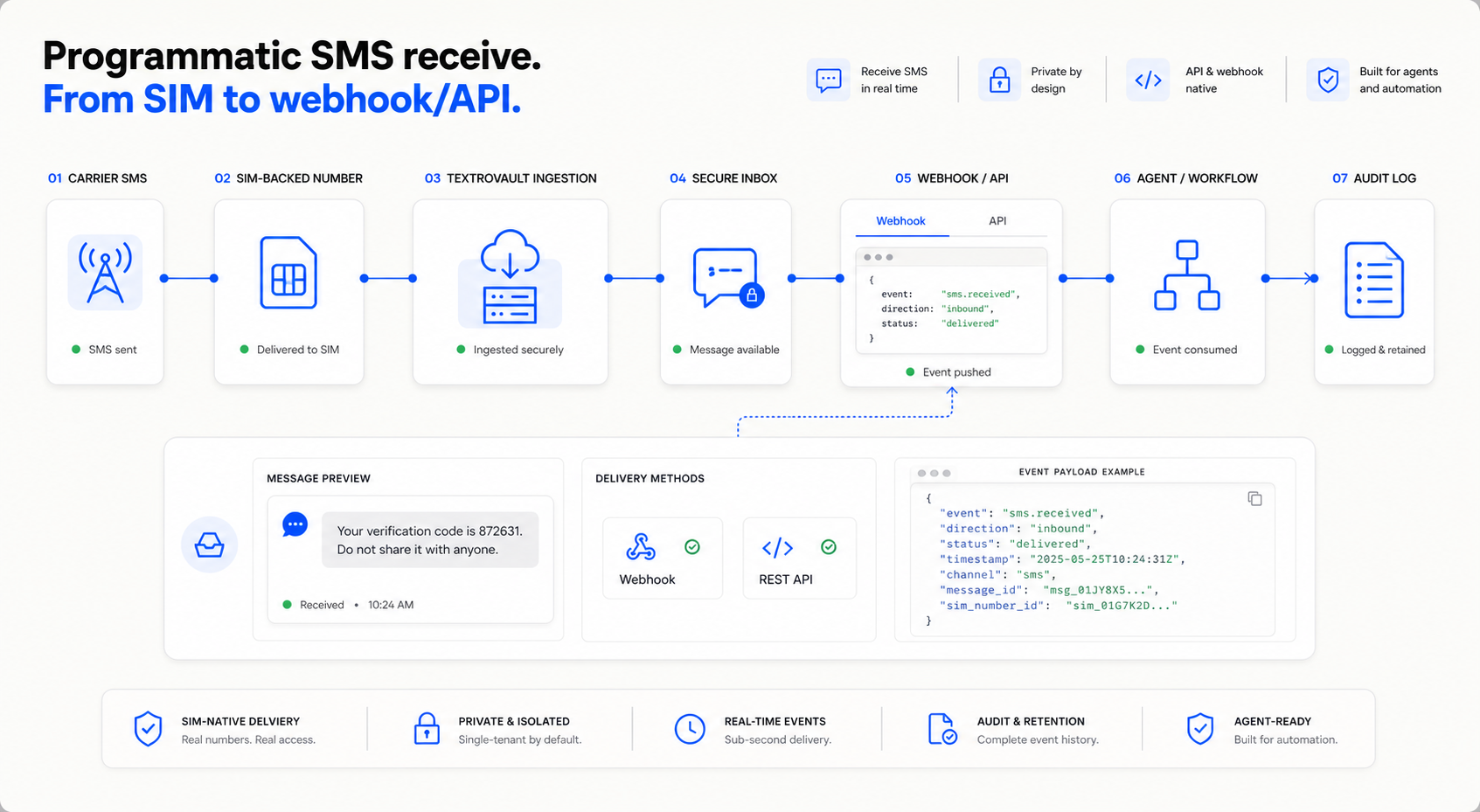
The basic flow is carrier SMS, SIM-backed number, Textrovault ingestion, secure inbox, API or webhook, agent or workflow, audit log.
SIM to webhook/API pipeline
- 01Carrier SMS
- 02SIM-backed number
- 03Textrovault ingestion
- 04Secure inbox
- 05Webhook / API
- 06Agent / workflow
- 07Audit log
The SIM-backed number handles the mobile-number side. Textrovault handles the software side. The operator gets a workflow event instead of a message locked inside a device.
API and webhooks are the software interface
Webhook delivery is a common pattern for programmable messaging. Twilio documents incoming message webhooks for Twilio phone numbers, and Vonage documents inbound SMS delivery to webhook endpoints. Textrovault uses the same general idea of turning inbound messages into software events, but its wedge is SIM-backed receive-only numbers for authorized agent and workflow use cases.
An API is useful when the agent or workflow wants to poll or retrieve messages. A webhook is useful when the workflow should be notified immediately when a message arrives. A dashboard is useful when a human operator needs to inspect, approve, or audit the message.
Pseudo-code shape: const message = await textrovault.messages.waitFor({ numberId, senderHint, timeoutSeconds: 120 }); if (message.policy === 'approved') return message.redactedBody; otherwise request human approval and log the decision.
Receiving the message is not the same as using it
The inbox should not be the policy. Receiving a message only means the event arrived. The system still needs to decide who can see it, whether the agent can use it, whether a human should approve it, and how the event should be logged.
- Sender matching checks whether the message came from an expected source.
- Workflow assignment checks whether the message belongs to the right agent, client, environment, or account group.
- Approval rules decide whether the agent can continue automatically or needs a human decision.
- Redaction limits unnecessary exposure of sensitive message content.
- Audit logs record message arrival, access decisions, webhook delivery, approvals, and agent use.
This matters because SMS can be part of authentication and recovery. NIST treats PSTN-based out-of-band authentication as a restricted authenticator and discusses risks around SIM changes, device swaps, number porting, and abnormal behavior. The operational lesson is that SMS access should be controlled, not treated as casual inbox access.
Where Textrovault fits
Textrovault provides dedicated SIM-backed numbers that can be assigned to an agent, client, workflow, brand, environment, account group, or shared operations inbox. Messages can be received through a secure inbox and exposed through API or webhooks where needed.
The goal is not to make every SMS automatically available to an agent. The goal is to make SMS assigned, software-readable, policy-bound, and logged.
Textrovault is for authorized workflows only: accounts, systems, clients, brands, test environments, and processes the operator owns, manages, or is explicitly allowed to operate. It is not for spam, impersonation, unauthorized access, account farming, ban evasion, or bypassing platform rules.
If your agent or automation needs SIM-backed SMS receive through a dashboard, API, webhooks, access controls, and logs, apply for early access to Textrovault.