

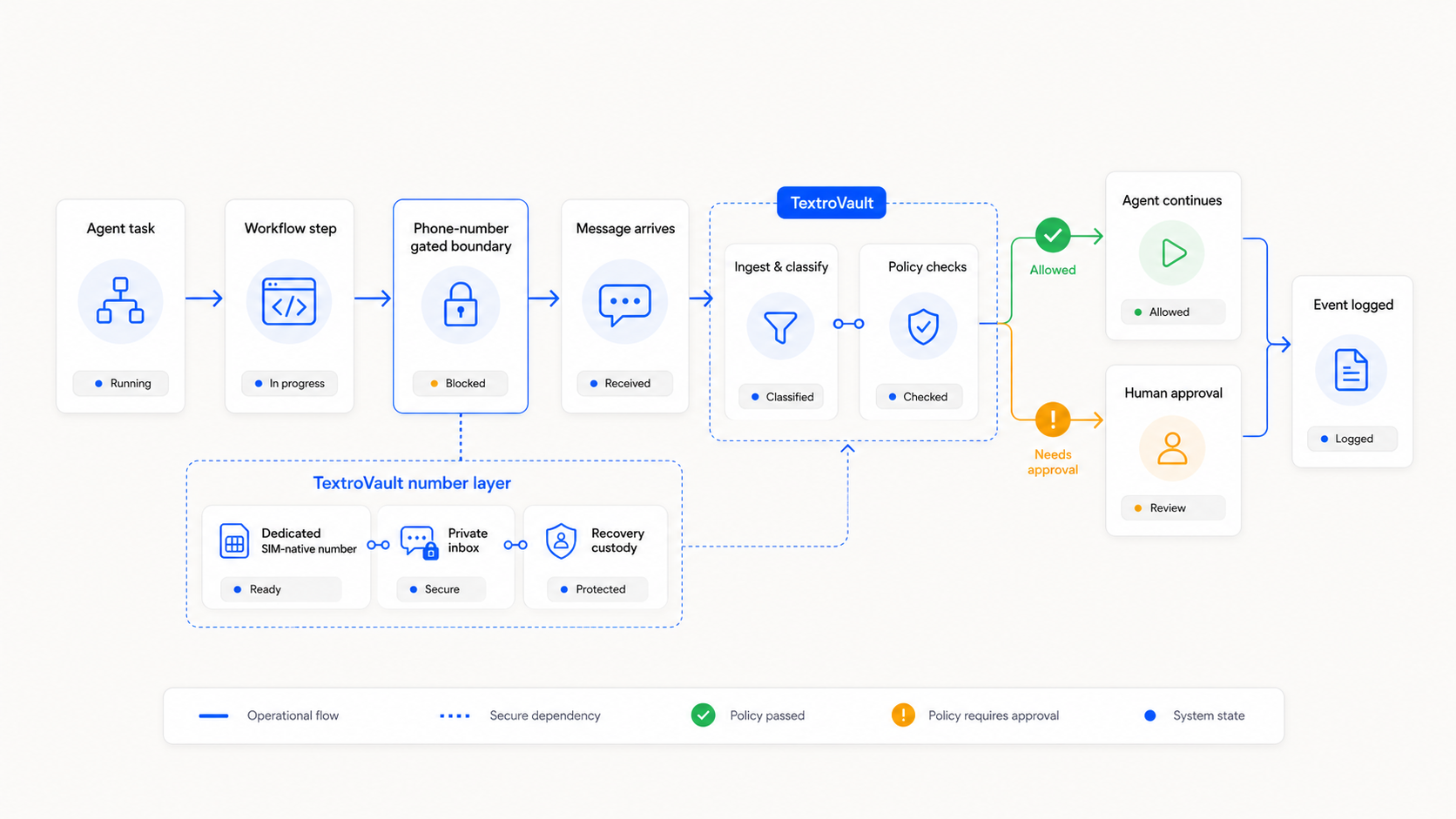
Agents get blocked at phone-number gates
AI agents do not only fail because of reasoning. They also fail when the workflow crosses a phone-number-gated step.
A phone-number-gated step is any point where the next action depends on a phone number: an SMS OTP, a WhatsApp registration message, an account alert, a recovery code, a re-verification message, or a mobile identity check.
The usual failure is simple. The agent can use the browser, call the tool, or continue the automation, but the required message lands on a human phone. The workflow stops and waits for the human.
This article is for technical operators building AI agents, browser automations, WhatsApp workflows, QA tests, and internal tools that should not depend on a founder’s, employee’s, contractor’s, or client’s personal phone number.
Not every phone-number gate is the same
The mistake is treating every phone message as the same kind of event. An OTP, an account alert, a recovery message, and a WhatsApp registration message have different risk profiles.
- An OTP may be needed for a specific authorized login or verification step.
- An account alert may need to be routed to an operator or workflow without exposing a personal phone.
- A recovery message may require human approval because it can affect long-term account access.
- A WhatsApp registration or re-verification message may define the phone identity behind a workflow.
- A QA or staging message may need realistic SMS receiving without involving a real person every time.
NIST treats PSTN-based out-of-band authentication as a restricted authenticator and describes risks around SIM changes, number porting, device swaps, and other indicators. The useful lesson for agent workflows is not that SMS disappears tomorrow. It is that phone-number-gated steps need policy, custody, and logging.
Meta’s Cloud API phone-number setup documentation also shows why phone access matters in WhatsApp workflows: the operator needs access to the phone number to receive the verification code during setup.
Design the gate as a state machine
The clean way to design a phone-number-gated workflow is to make the gate explicit. Do not rely on a human noticing a message and manually deciding what to do. Treat the phone-number step as a state in the workflow.
Phone-number-gated workflow state machine
- 01Agent starts task
- 02Reaches phone-number-gated step
- 03Message or code arrives
- 04Textrovault classifies
- 05Policy checks
- 06Agent continues or human approves
- 07Event logged
This state machine separates two questions that are often mixed together: did the message arrive, and who is allowed to use it. The first is a delivery problem. The second is a policy problem.
The agent should not automatically see every message
A phone-number-gated workflow should not mean that the agent gets unrestricted access to every message. Some messages can be routed directly to the workflow. Others should require human approval.
- Low-risk QA messages can usually be routed directly to the test workflow.
- Operational alerts can be forwarded to the agent or notification pipeline if the workflow only needs awareness.
- Recovery messages should usually require human approval before the agent can use them.
- Account setup or re-verification messages should be tied to an authorized workflow and logged.
- Messages outside the expected sender, number, or workflow should be escalated instead of automatically used.
The continuation path should be explicit. If the policy allows it, the agent continues. If the policy requires approval, a human approves or denies. If the message is unexpected, the workflow escalates. In all cases, the event should be logged.
Where Textrovault fits
Textrovault is built for the phone-number layer of authorized workflows. It gives an agent, client, workflow, brand, or test environment a dedicated SIM-based number. Messages can be received through a dashboard and exposed through API or webhooks where needed.
The point is not to make every phone-number gate automatic. The point is to make the gate assigned, visible, policy-bound, and logged. A phone-number-gated step should not be hidden on a human’s personal phone.
Textrovault is for authorized workflows only: accounts, systems, clients, brands, test environments, and processes the operator owns, manages, or is explicitly allowed to operate. It is not for spam, impersonation, unauthorized access, account farming, ban evasion, or bypassing platform rules.
If your agent or automation currently stops when a message reaches a human phone, identify the phone-number-gated step. If that step needs a dedicated SIM-based number with dashboard access, API/webhooks, access controls, and logs, apply for early access to Textrovault.