

Agent-readable SMS does not mean automatic access
Agents should not automatically see every SMS or verification message. That is the wrong default for serious infrastructure.
Some messages are low-risk workflow events. Others can affect account access, recovery, ownership, or customer communication. A QA test message and an account recovery code should not follow the same policy.
This article is for technical operators, AI automation agencies, WhatsApp consultants, QA teams, and internal teams that want agents to receive SMS without turning the phone-number layer into uncontrolled access.
Different SMS messages need different policies
The first step is to classify the message. A phone-number workflow may receive OTPs, account alerts, recovery messages, reverification codes, setup messages, customer notifications, and QA test messages. They are not equivalent.
- QA and staging messages can often be routed directly to a test workflow.
- Operational alerts may be routed to an agent or notification pipeline if the workflow only needs awareness.
- OTP messages may require sender matching, workflow matching, and limited-use handling.
- Recovery and reverification messages should usually require human approval before agent use.
- Unexpected senders or unexpected message types should be escalated instead of automatically used.
NIST treats PSTN-based out-of-band authentication as a restricted authenticator and discusses risks around SIM changes, number porting, device swaps, and abnormal behavior. The practical lesson for agent workflows is that SMS-based access needs policy and review, not blind automation.
Use a human-in-the-loop approval flow
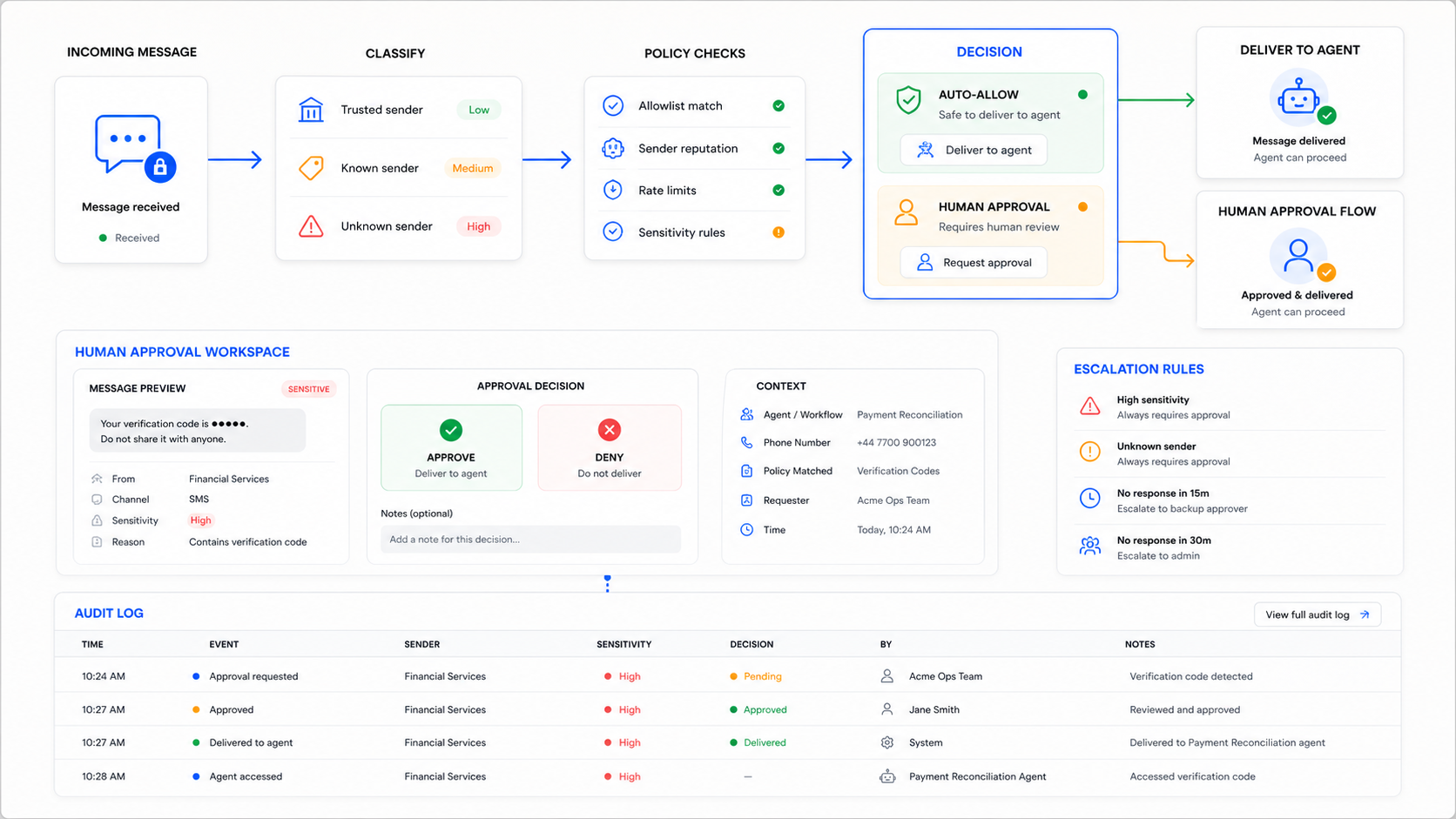
The clean pattern is to separate message arrival from message use. Receiving the SMS is one event. Deciding whether the agent can use it is a separate policy decision.
Human-in-the-loop approval flow
- 01Incoming SMS
- 02Sender allowlist
- 03Message classification
- 04Redacted preview
- 05Automatic access or human approval
- 06Agent continues
- 07Audit log
This flow prevents the common mistake of treating the inbox as the policy. The inbox only receives the message. The policy decides whether the agent should see it, whether a human should approve it, or whether the event should be escalated.
The control layer needs specific rules
A serious approval system should be explicit. It should not depend on an operator manually reading every message and deciding from memory.
- Sender allowlists define which senders are expected for the workflow.
- Workflow matching prevents a message for one workflow from being used by another.
- OTP policies define whether the agent can use a code directly or needs approval.
- Redaction limits unnecessary exposure of sensitive message content.
- Escalation rules route unexpected or sensitive messages to a human.
- Audit logs record message arrival, access decisions, approvals, denials, and agent use.
The strongest default is not maximum autonomy. The strongest default is controlled autonomy. Let the agent continue when the workflow and policy allow it. Require human approval when the message affects recovery, account setup, reverification, or sensitive access.
Where Textrovault fits
Textrovault provides dedicated SIM-based numbers for authorized workflows. A number can be assigned to an agent, client, workflow, brand, environment, or account group. Messages can be received through a dashboard and exposed through API or webhooks where needed.
The point is not to let agents read every SMS. The point is to make SMS access assigned, policy-bound, approvable, and logged. That is the difference between infrastructure and a risky inbox.
Textrovault is for authorized workflows only: accounts, systems, clients, brands, test environments, and processes the operator owns, manages, or is explicitly allowed to operate. It is not for spam, impersonation, unauthorized access, account farming, ban evasion, or bypassing platform rules.
If your agent or automation needs SMS access but some messages should require human approval, apply for early access to Textrovault.