

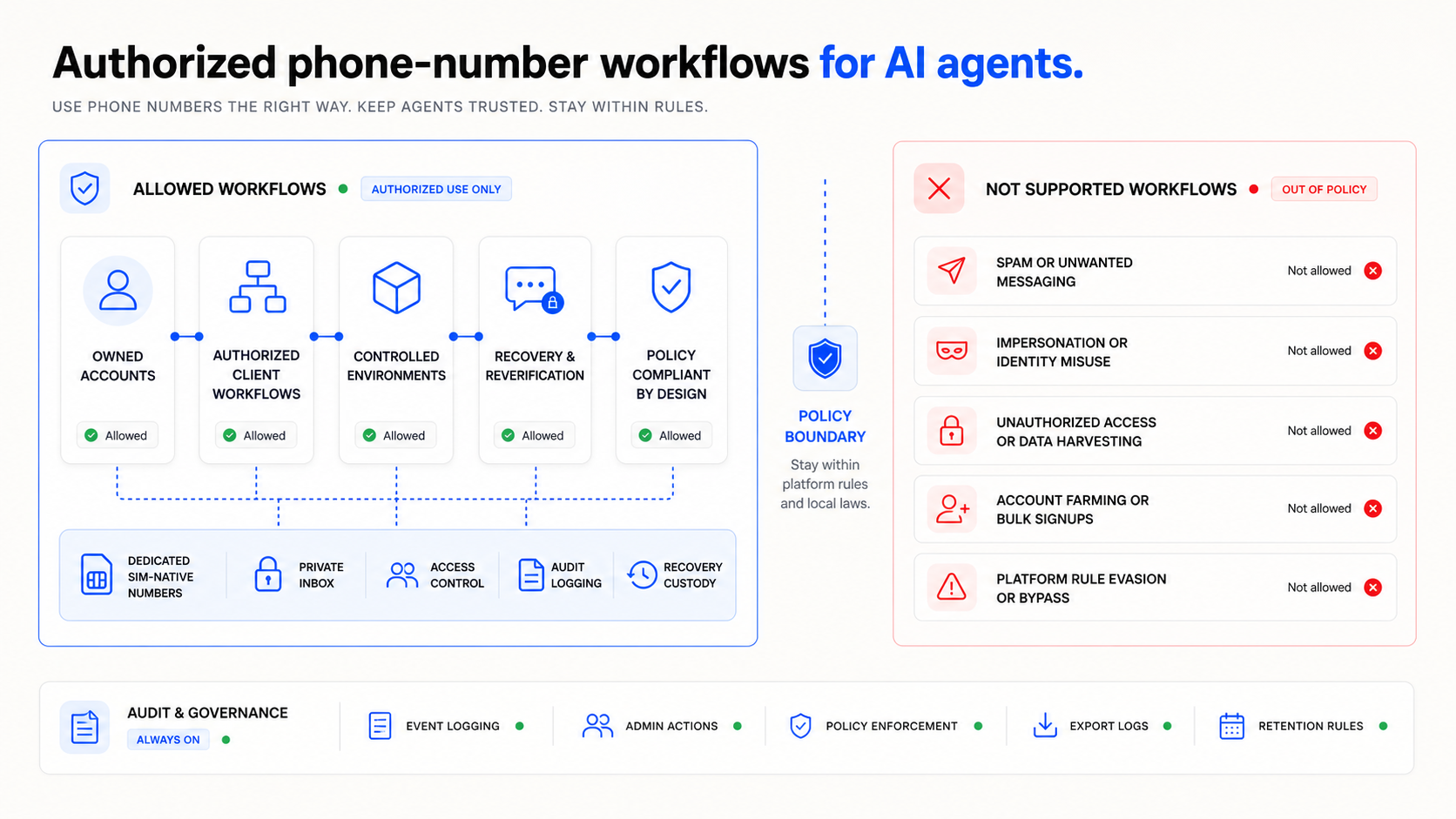
Authorization comes before automation
Agent-readable phone-number infrastructure only makes sense for authorized workflows. The operator must own, manage, or have explicit permission to operate the account, system, client workflow, brand, or test environment behind the number.
This is the first boundary for Textrovault. The product is not public verification tooling. It is not disposable-number infrastructure. It is not for bypassing platform rules. It is built for legitimate workflows where a phone number should be assigned, recoverable, controlled, and logged.
This article is for technical operators, AI automation agencies, WhatsApp consultants, QA teams, and internal teams that want agents or automations to receive SMS, notifications, account alerts, recovery messages, or phone-number-based workflow events without using personal phones or public inboxes.
What counts as an authorized workflow
An authorized workflow is not defined by whether the operator can technically receive a message. It is defined by whether the operator has the right to operate the account, system, client process, or test environment that the message belongs to.
- An internal agent receiving account alerts for systems the company owns.
- A QA environment receiving SMS for a product or test account the team controls.
- An agency-managed client workflow where the client has explicitly authorized the agency to operate the number and account workflow.
- A WhatsApp or messaging workflow where the operator owns or is authorized to manage the account and number.
- A recovery or reverification flow where the operator is responsible for the account and the workflow is documented.
- A client, brand, workflow, or environment with clear number assignment, recovery access, and handoff rules.
In these cases, the phone number is part of the system. It should have an owner, an access policy, a recovery path, and a log.
What Textrovault is not for
Textrovault rejects the disposable-number category. A serious number workflow is not anonymous, public, or unowned. It is assigned to a real operator, workflow, client, brand, environment, or system.
- No impersonation.
- No spam.
- No unauthorized messaging.
- No account farming.
- No public disposable verification.
- No ban evasion.
- No platform-rule bypassing.
- No workflows where the operator does not own, manage, or have explicit permission to operate the account or system.
This boundary matters because phone-number infrastructure can be abused. WhatsApp’s Business Messaging Policy describes enforcement for violations, low-quality experiences, harmful activity, and unauthorized scale messaging. NIST also treats PSTN-based out-of-band authentication as a restricted authenticator and discusses risks around SIM changes, device swaps, number porting, and abnormal behavior.
Textrovault is infrastructure, not bypass tooling
Textrovault provides dedicated SIM-based numbers for authorized workflows. A number can be assigned to an agent, client, brand, workflow, account group, or test environment. Messages can be received through a dashboard and exposed through API or webhooks where needed.
The product’s job is to make the phone-number layer manageable: assigned numbers, SMS receive, access controls, custody, recovery visibility, logs, and revocation. It does not make unauthorized workflows acceptable. It does not make platform violations safe. It does not make public disposable verification legitimate.
If your agent or automation needs phone-number access for an account, client, workflow, brand, environment, or system you own, manage, or are explicitly allowed to operate, apply for early access to Textrovault.