

The number should be assigned to the work
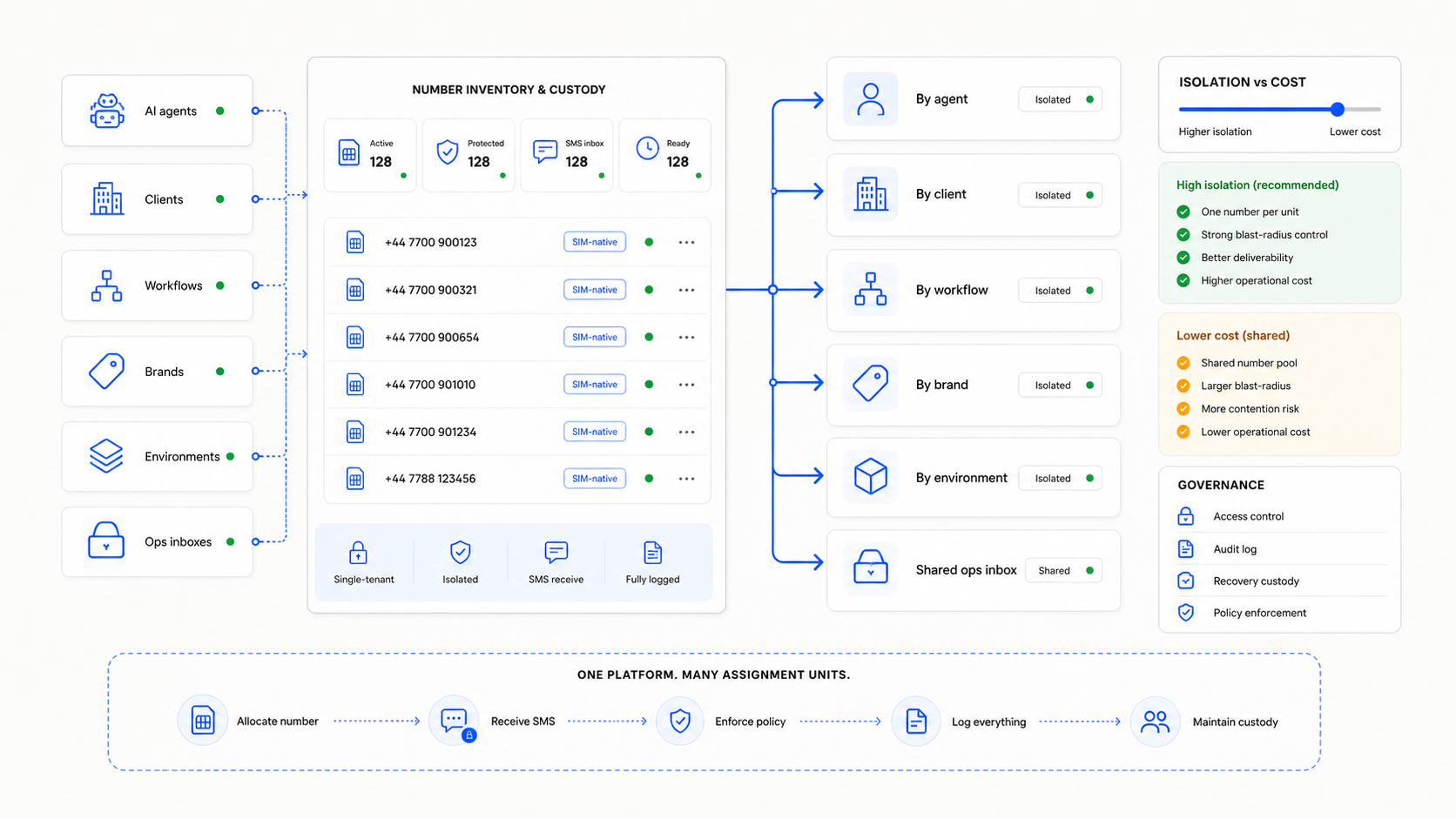
In agentic systems, the right unit is not always one number per person. The number may need to belong to an agent, client, brand, workflow, account group, test environment, or shared operations inbox.
This matters because the number is not only a place where SMS arrives. It can also become the recovery path, WhatsApp identity, account-facing surface, verification endpoint, and custody object behind the workflow.
This article is for technical operators, AI automation agencies, WhatsApp consultants, QA teams, and internal ops teams deciding how many numbers they need and what each number should belong to.
The main assignment units
Use one number per agent when the agent needs a persistent external identity. This can apply to WhatsApp agents, account-monitoring agents, support agents, or long-running operational agents.
Use one number per client when an agency builds separate client workflows. The client number should not be mixed with another client’s workflow or with the agency founder’s personal number.
Use one number per brand when one business operates multiple brands, stores, or customer-facing identities. A shared number may be cheaper, but it can blur customer recognition and recovery ownership.
Use one number per workflow when the workflow has its own recovery, approval, or logging requirements. Use one number per environment when dev, staging, and production should be isolated.
Use a shared ops inbox only when the messages belong to the same team, have the same access policy, and do not need separate client, brand, or environment ownership.
Use a decision tree, not a guess
Number assignment decision tree
- 01Does the workflow need its own persistent identity? Use per-agent.
- 02Does a client need separate ownership? Use per-client.
- 03Does a brand or storefront need recognition? Use per-brand.
- 04Does recovery policy differ by job? Use per-workflow.
- 05Can test traffic touch production identity? If not, split dev, staging, and production.
- 06Are workflows related and low-risk? A shared ops inbox may be enough.
The decision tree is not meant to maximize the number count. It is meant to prevent the wrong number from becoming hidden infrastructure. The goal is to assign the number to the smallest operational unit that needs separate ownership, recovery, policy, or logs.
The tradeoff is cost versus isolation
More numbers create more isolation. They also create more inventory, cost, billing, documentation, and support work. Fewer numbers are simpler, but they concentrate risk and make handoff harder.
A practical estimate starts with ownership boundaries. Count clients, brands, production workflows, environments, and agents that need persistent external identity. Then remove cases where a shared ops inbox is acceptable because the messages belong to the same owner, same team, and same policy.
For an agency, a simple first estimate is one number per client workflow. For a product team, it may be one number per environment. For a WhatsApp agent operator, it may be one number per serious agent. For a QA team, it may be one number per test environment or account group.
Do not optimize only for monthly number cost. Optimize for recovery, continuity, handoff, logging, and blast radius. The cheapest number model can become expensive when the wrong person owns the recovery path.
Where Textrovault fits
Textrovault provides dedicated SIM-based numbers that can be assigned to agents, clients, brands, workflows, environments, account groups, or shared ops inboxes. The number can receive SMS, appear in a dashboard, connect to API or webhooks where needed, and carry access controls and logs.
This makes number assignment explicit. The operator can know which number belongs to which workflow, who can access messages, what recovery path exists, and when a message was received or used.
Textrovault does not replace WhatsApp Business API onboarding, CPaaS, CRMs, helpdesks, or agent frameworks. It fills the SIM-based phone-number layer those workflows often assume but do not manage cleanly.
Textrovault is for authorized workflows only: accounts, systems, clients, brands, test environments, and processes the operator owns, manages, or is explicitly allowed to operate. It is not for spam, impersonation, unauthorized access, account farming, ban evasion, or bypassing platform rules.
If you need to assign SIM-based numbers to agents, clients, workflows, or environments with SMS receive, access controls, and logs, apply for early access to Textrovault.