

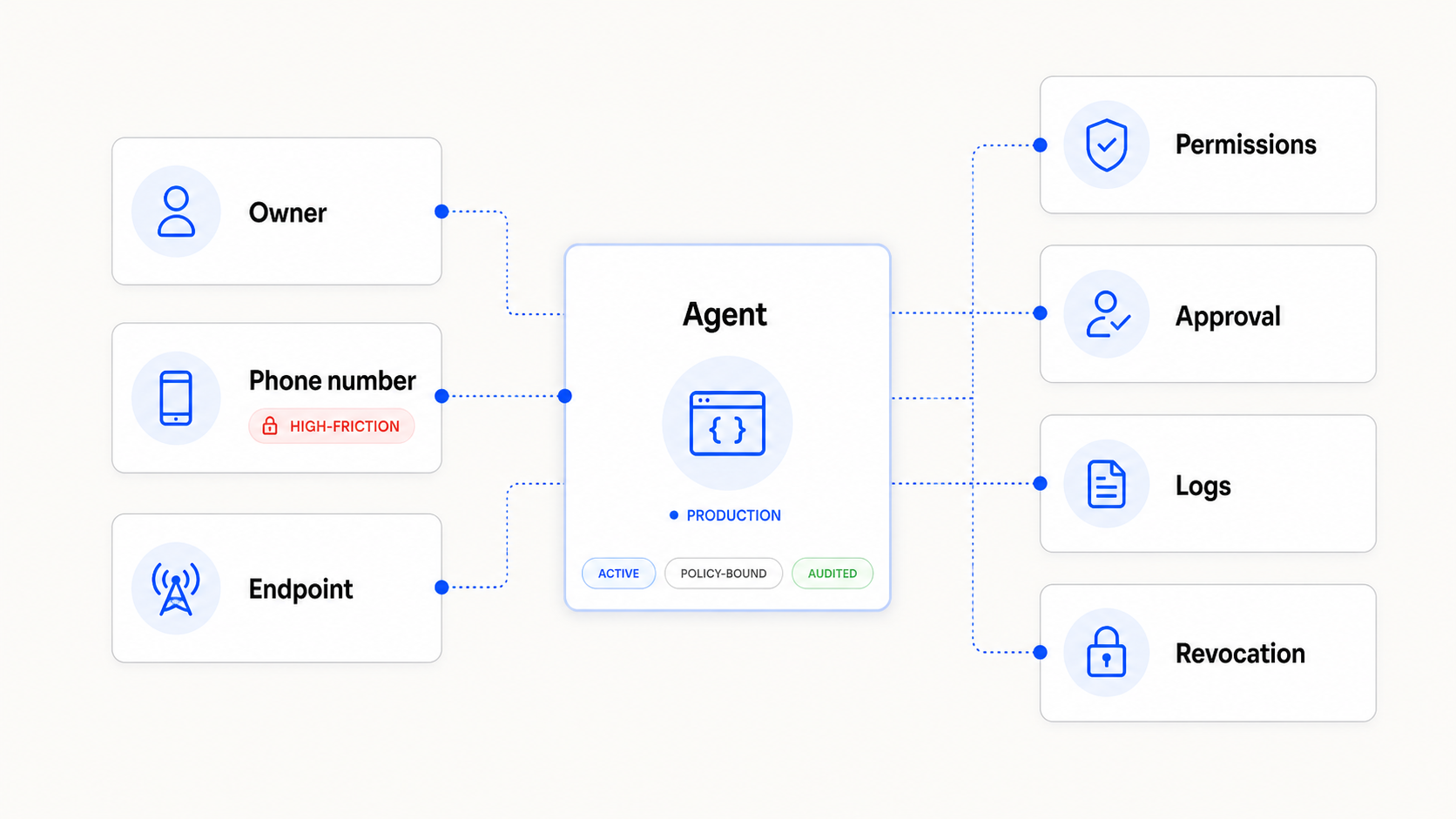
Agents need operational identities
Production AI agents need operational identities. They should not run through a human’s personal phone number, recovery channel, messaging account, inbox, or private browser session.
An operational identity answers practical questions: who owns the agent, what endpoints it can use, which workflows it is allowed to touch, what requires approval, what gets logged, and how access is revoked.
A phone number is not the whole identity. It is one high-friction credential inside the identity. It matters because it can control SMS, WhatsApp setup, recovery, alerts, reverification, and account-facing communication.
This article is for technical operators, AI automation agencies, WhatsApp builders, QA teams, and internal teams deploying agents that touch real accounts, clients, workflows, or systems.
The thesis makes sense after the concrete failures
The broad agent identity thesis should not be the first thing a market hears. It is too abstract before the operator sees the failure modes.
The concrete failures come first: an OpenClaw WhatsApp agent runs on a personal number; a Baileys workflow depends on an unmanaged phone identity; a WhatsApp Business API setup stalls because the number is already tied to the wrong app account; an agency cannot hand off a client workflow cleanly; a recovery code arrives six months later and nobody knows who controls the number.
After those failures are visible, the larger pattern is obvious. The problem is not just SMS. The problem is that the agent is doing operational work while borrowing human identity infrastructure.
The agent phone identity model
The useful model is not one number per human. The useful model is one controlled identity per production agent, workflow, client, brand, environment, or account group where the phone number is part of the operating surface.
Agent operational identity model
| Identity layer | What it controls | Why it matters |
|---|---|---|
| Owner | Who is responsible for the agent | Accountability and custody |
| Endpoint | Where the agent receives messages or events | Routable communication |
| Phone number | SMS and phone-number-based account surface | High-friction credential |
| Permissions | What the agent can access | Scope control |
| Approval rules | What requires human decision | Safe continuation |
| Logs | What happened and who accessed it | Auditability |
| Revocation | How access is removed | Incident response and handoff |
Owner
- What it controls
- Who is responsible for the agent
- Why it matters
- Accountability and custody
Endpoint
- What it controls
- Where the agent receives messages or events
- Why it matters
- Routable communication
Phone number
- What it controls
- SMS and phone-number-based account surface
- Why it matters
- High-friction credential
Permissions
- What it controls
- What the agent can access
- Why it matters
- Scope control
Approval rules
- What it controls
- What requires human decision
- Why it matters
- Safe continuation
Logs
- What it controls
- What happened and who accessed it
- Why it matters
- Auditability
Revocation
- What it controls
- How access is removed
- Why it matters
- Incident response and handoff
The phone number row is the Textrovault wedge. It is where operational identity meets legacy communication infrastructure.
Phone numbers are hard credentials
Phone numbers are hard credentials because they are not just labels. They can be used for SMS delivery, account verification, WhatsApp identity, account alerts, recovery, reverification, and customer recognition.
That makes them harder to manage than a normal metadata field. If the wrong person owns the number, recovery breaks. If the number is shared across clients or environments, blast radius grows. If the number is public or disposable, privacy and accountability fail. If the number is virtual but the workflow needs a real mobile endpoint, the primitive may be wrong.
NIST treats PSTN-based out-of-band authentication as a restricted authenticator and discusses risks around SIM changes, device swaps, number porting, and abnormal behavior. The practical lesson for agent operators is not that SMS disappears tomorrow. It is that phone-number access needs custody, policy, and logging.
A production agent should therefore not inherit a founder’s phone number, an employee SIM, a public inbox, or an unmanaged spare phone as its identity layer.
Where Textrovault fits
Textrovault starts with the phone-number layer of agent identity. It provides dedicated SIM-based numbers that can be assigned to agents, clients, workflows, brands, environments, account groups, or shared operations inboxes.
Messages can be received through a dashboard and exposed through API or webhooks where needed. Access controls, approval paths, custody records, and logs make the number manageable instead of personal, public, or undocumented.
Textrovault does not replace agent frameworks, CRMs, WhatsApp Business API onboarding, CPaaS, identity providers, or security programs. It fills one specific hard layer those systems often assume but do not manage cleanly: SIM-based phone-number custody for authorized workflows.
Textrovault is for authorized workflows only: accounts, systems, clients, brands, test environments, and processes the operator owns, manages, or is explicitly allowed to operate. It is not for spam, impersonation, unauthorized access, account farming, ban evasion, or bypassing platform rules.
If your production agent needs a phone-number identity with SMS receive, custody, access controls, and logs, apply for early access to Textrovault.