

The first code is not the hard part
Getting the first verification code is not enough. Serious workflows need long-term access to the number behind the account.
A number used today for setup may be needed again for reverification, account recovery, security alerts, ownership transfer, client handoff, or incident response. If that number belongs to a founder, employee, contractor, or unmanaged spare SIM, the workflow may work at first and fail later.
This article is for technical operators, AI automation agencies, WhatsApp consultants, QA teams, and internal ops teams that use phone numbers as part of agent, account, client, or workflow infrastructure.
The number becomes the recovery path
In many systems, the phone number is not only used once. It can become the path for account recovery, reverification, security alerts, device changes, or setup confirmation.
NIST treats PSTN-based out-of-band authentication as a restricted authenticator and discusses risks such as SIM changes, device swaps, number porting, and abnormal behavior. The useful lesson for operators is simple: phone-number access is a risk surface and should be governed.
Meta’s Cloud API phone-number setup documentation also shows the operational role of number access. The operator needs access to the phone number to receive the verification code during setup, and numbers already registered with WhatsApp Messenger or the WhatsApp Business App may need deletion or migration before onboarding.
The first verification event may be easy. The hard question is who can receive the next one.
Employee-owned numbers are dangerous infrastructure
Employee-owned SIMs and founder-owned numbers are attractive because they are available. They are also fragile. The person can leave, lose the device, change the number, travel, ignore the message, or refuse handoff.
The workflow then inherits a personal custody problem. The account may belong to the business, but the recovery path belongs to a person. The agent may be operational, but reverification still depends on a human phone.
The same problem appears in agency work. A client workflow may be delivered on one number, but nobody documents who owns the number, who can receive future codes, who can approve recovery, or what happens after handoff.
- Initial setup works, but reverification fails months later.
- An employee leaves and the number is no longer accessible.
- A client asks for handoff, but number ownership is unclear.
- A recovery message arrives, but nobody knows who should approve it.
- A security alert is received, but there is no workflow record.
Treat the number as a lifecycle object
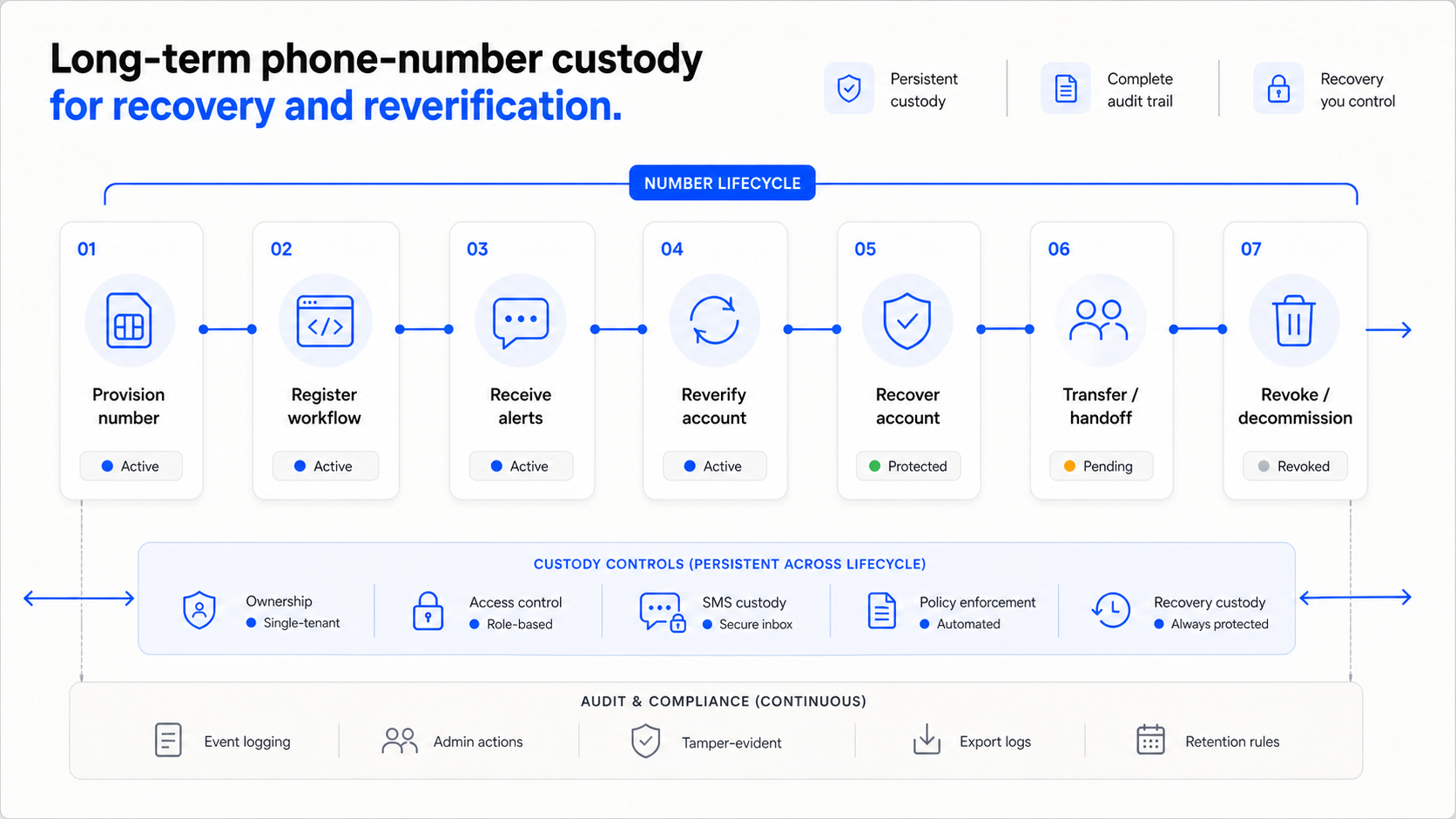
A serious phone-number workflow needs a lifecycle, not a one-time setup note. The number should be provisioned, assigned, used, monitored, recovered, handed off, and eventually revoked or decommissioned.
Phone-number custody lifecycle
- 01Provision number
- 02Register account / workflow
- 03Receive alerts
- 04Reverify
- 05Recover
- 06Transfer / handoff
- 07Revoke / decommission
The lifecycle matters because recovery usually fails outside the original happy path. It fails when the person who set up the number is unavailable, when the client relationship changes, or when the workflow needs a code nobody expected to need again.
Where Textrovault fits
Textrovault provides dedicated SIM-based numbers that can be assigned to an agent, client, workflow, brand, environment, or account group. Messages can be received through a dashboard and exposed through API or webhooks where needed.
The value is not only receiving the first code. The value is long-term custody: knowing which number belongs to which workflow, who can access messages, how recovery is handled, what was logged, and how the number can be handed off or decommissioned.
Textrovault is for authorized workflows only: accounts, systems, clients, brands, test environments, and processes the operator owns, manages, or is explicitly allowed to operate. It is not for spam, impersonation, unauthorized access, account farming, ban evasion, or bypassing platform rules.
If your agent, WhatsApp workflow, account setup, or client deployment depends on future access to a phone number, treat the number as infrastructure. If that number needs SMS receive, custody, access controls, and logs, apply for early access to Textrovault.