

AI agents are becoming operators
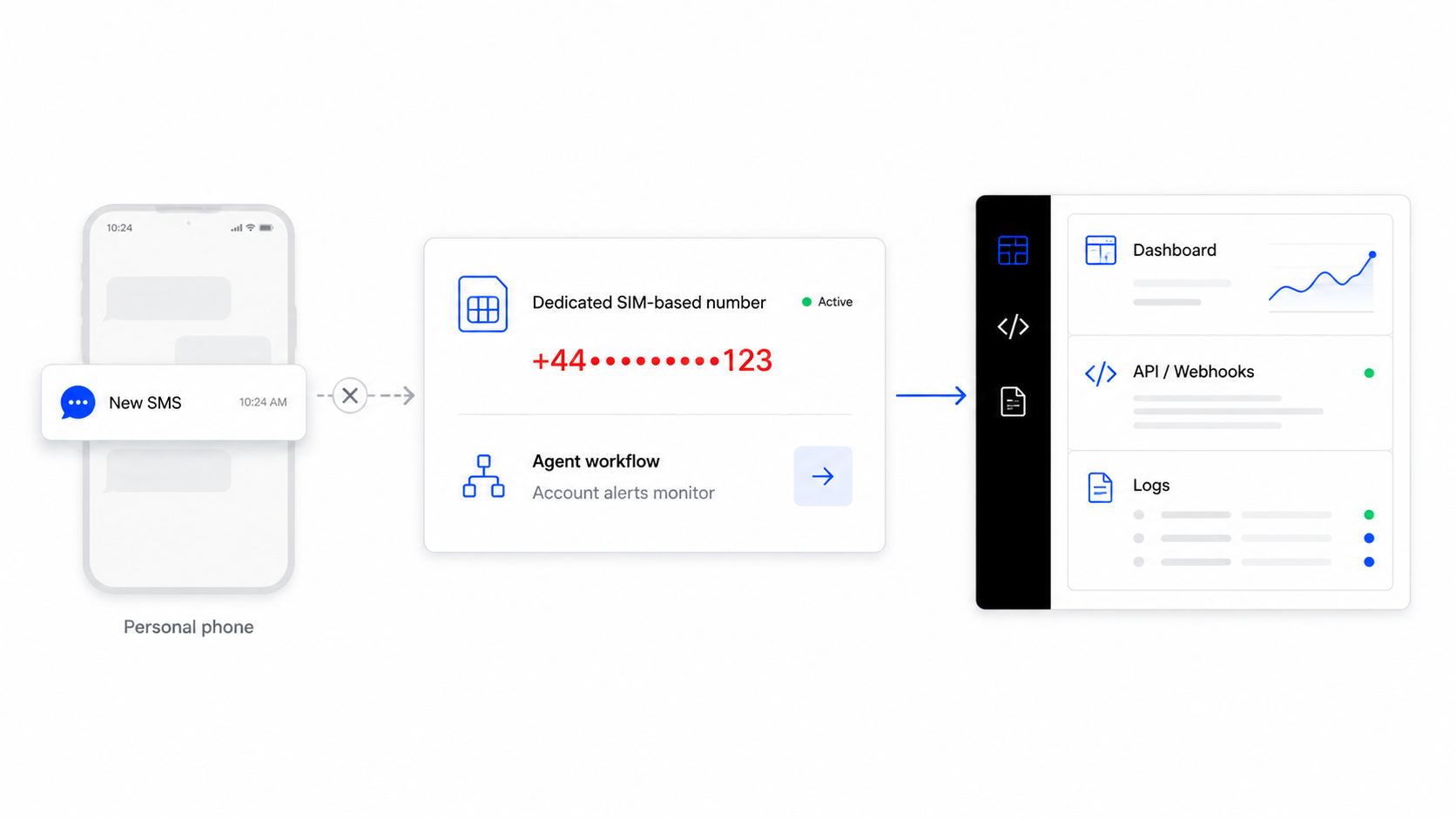
AI agents are becoming operators, but many still depend on their operators' personal phone numbers. We think it is a weakness. The workflow stops when an SMS lands on your own phone, and the agent's activity gets tied to your own private identity. We strongly emphasize that serious and legitimate agents need their own dedicated, governed phone number for SMS, notifications, authorized account recovery and account setup flows, and account-facing communication.
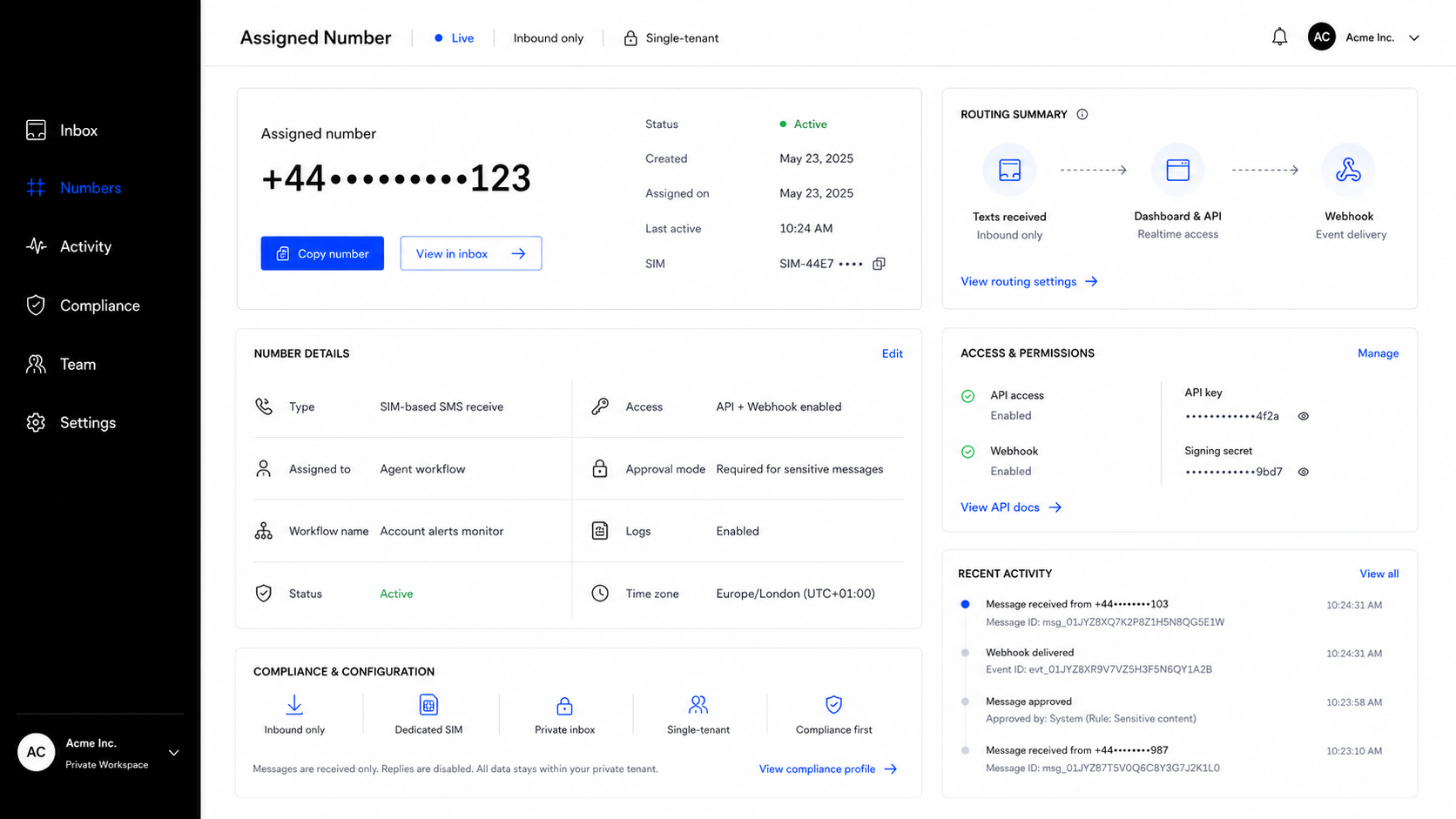
For many legitimate workflows, a SIM-based number is the right option, rather than a public inbox, a borrowed human phone, or a virtual/VoIP number workaround. Textrovault is built to fill this gap by providing dedicated SIM-based numbers to your AI agents with dashboard access, API/webhooks, access controls and logs.
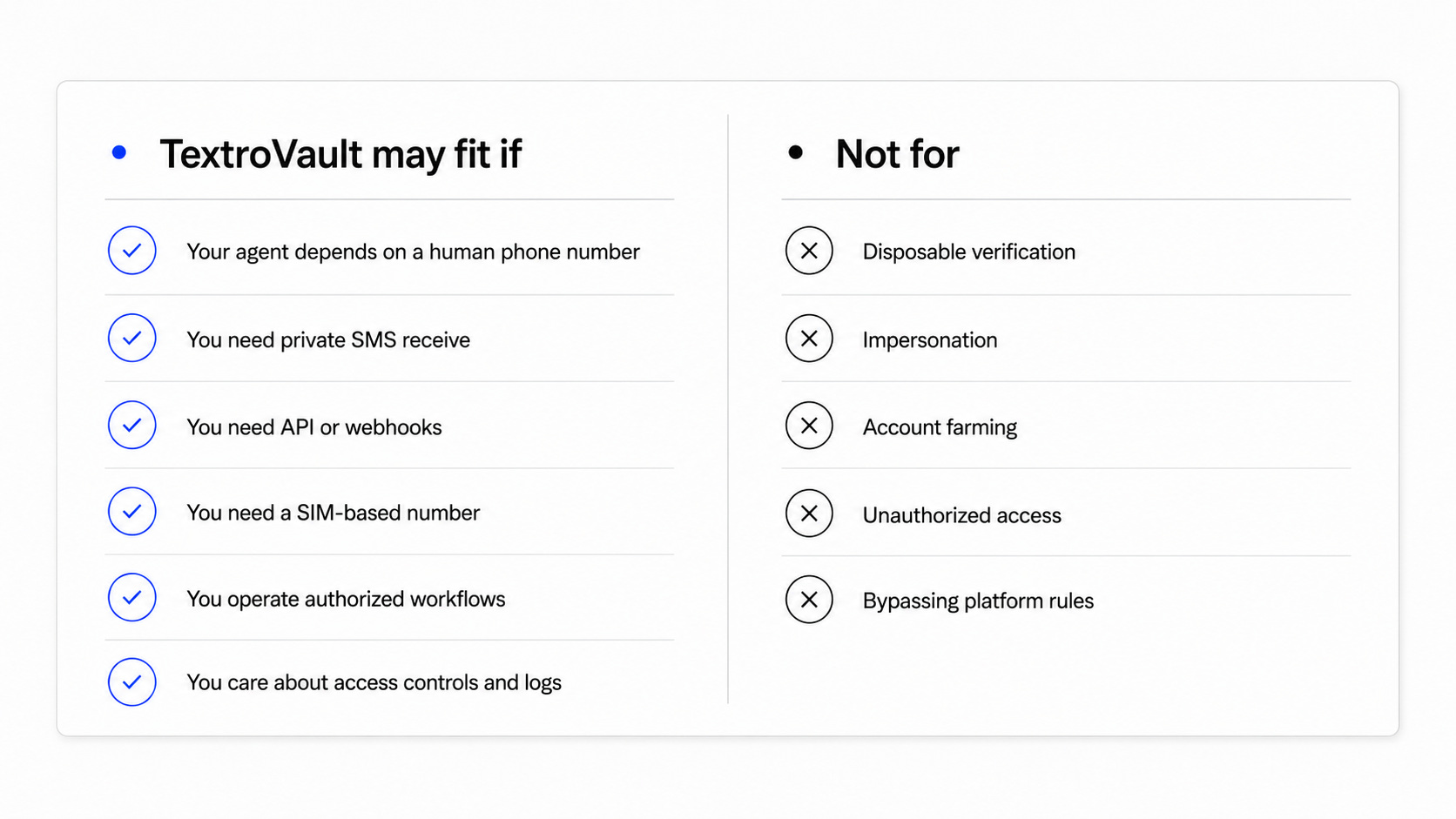
Textrovault is primarily focused on technical operators building agents or automations that should not expose or depend on a founder's, employee's, contractor's, or client's personal phone number. Textrovault can only be used for authorized workflows: accounts, systems, and processes the operator owns, manages, or is explicitly allowed to operate.
EARLY ACCESS
Building an authorized agent workflow that should not depend on a personal phone number?
The human phone becomes an invisible dependency
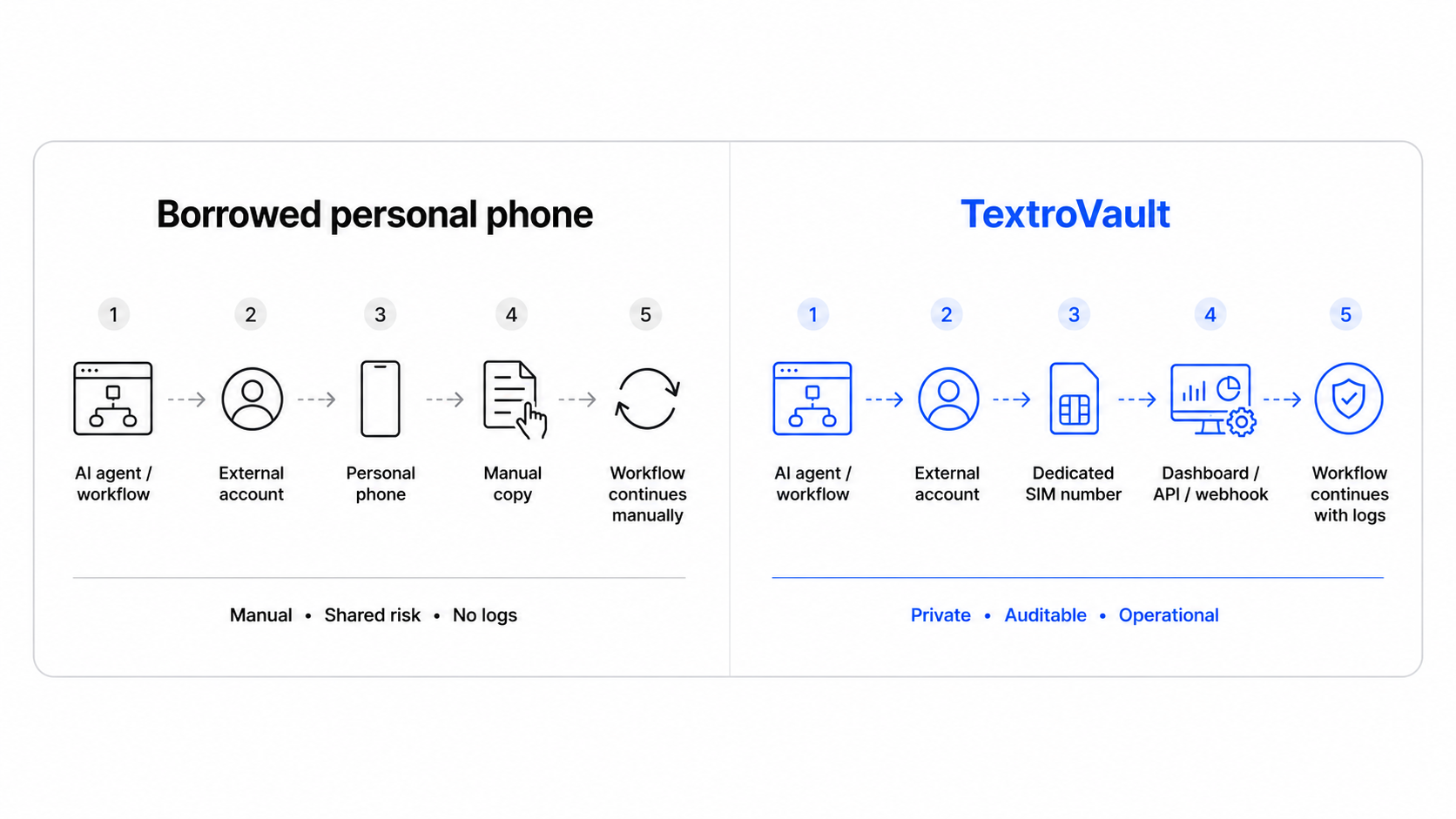
This situation is already visible in how technical operators are starting to use agents. Agents are being pointed at websites, dashboards, inboxes, CRMs, internal tools, testing flows, and customer/account workflows. The agent may monitor something, fill a form, check a status page, handle an alert, prepare a response, test a product flow, or continue a browser task. The work is increasingly done by the agent, but the phone number is still usually owned by a human.
That creates an awkward setup. The agent is assigned operational work, but the required SMS, notification, recovery message, or account-facing communication goes to a founder, employee, contractor, or client. The workflow is therefore not actually controlled by the software system running it. It is partly controlled by whoever has the phone. That person becomes an invisible dependency inside the automation.
The phone number is attached to the wrong thing
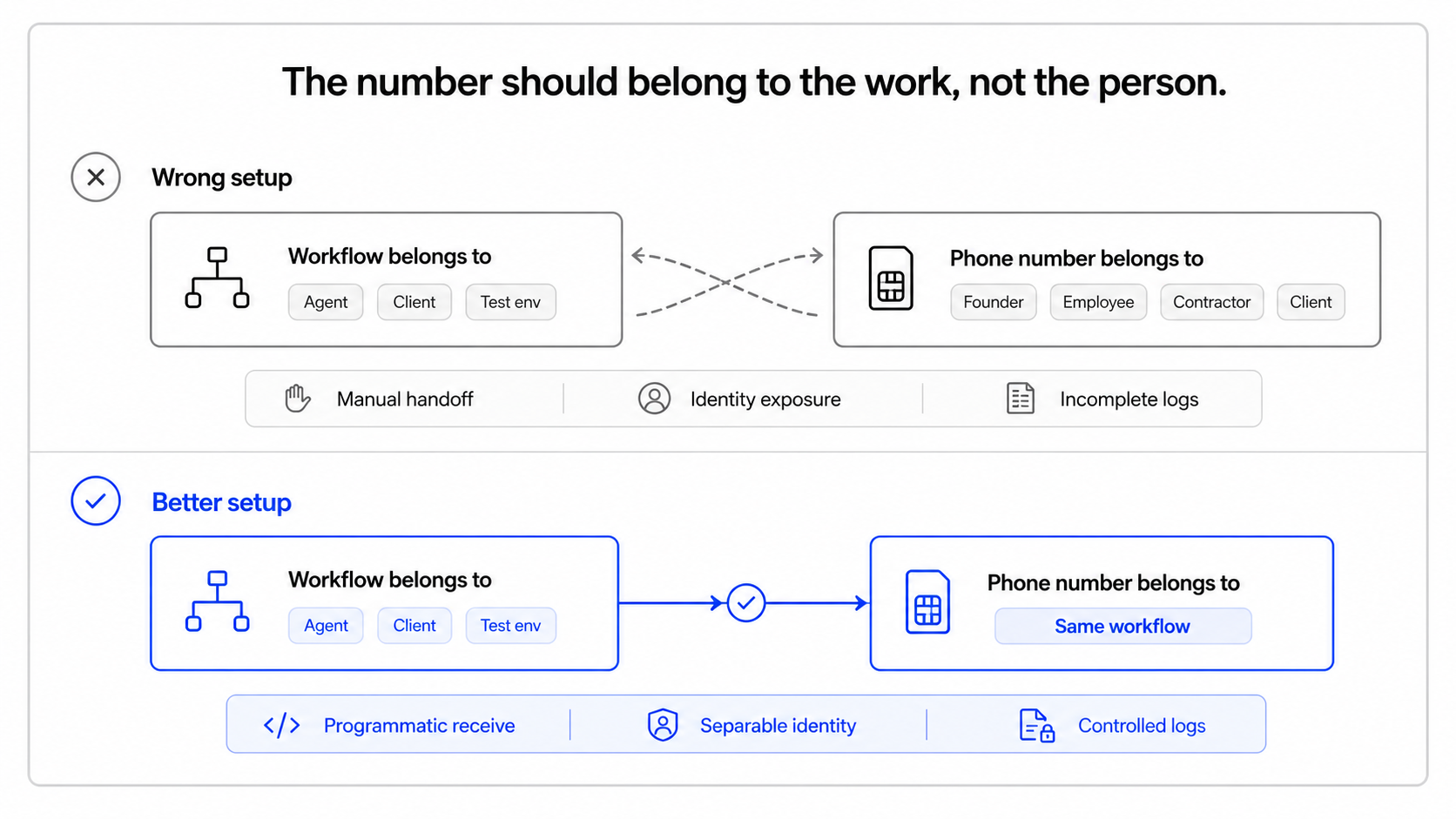
The mechanism is simple: the phone number is attached to the wrong thing. The workflow belongs to the agent, business, client, or test environment, but the phone number belongs to a person. So every SMS creates a handoff. The agent waits. The person checks the message. The person decides what to share. The workflow continues only after that person acts. This weakens the autonomy the operator is trying to create.
Textrovault turns SIM-based SMS into software
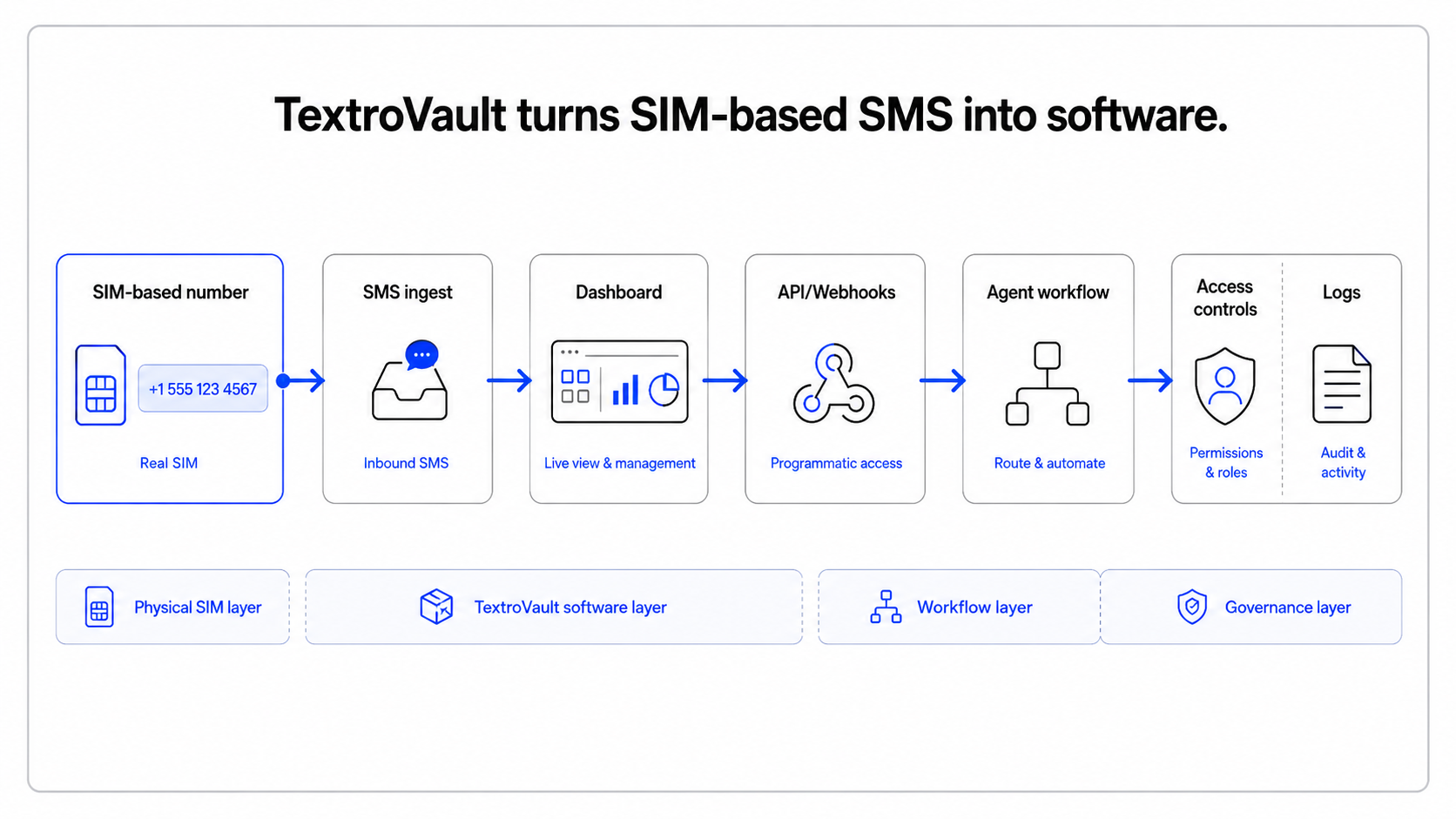
Textrovault's answer is not just "use a different phone number." The actual capability is programmatic SMS receiving from dedicated SIM-based phone numbers. A number is assigned to the agent, workflow, client, or test environment. When an SMS arrives, Textrovault receives it and makes it available through the dashboard, API, or webhooks. The agent or automation can then react to the message as part of the workflow instead of waiting for someone to read a personal phone.
This is the unique part: the number is SIM-based, but the workflow experience is software-native. The operator gets the practical value of a real mobile/SIM number while still being able to connect it to agent workflows, browser automations, QA tests, internal tools, and notification pipelines. The SMS does not stay trapped on a device. It becomes an event that software can receive, route, control, and log.
The risk grows when the phone number stays personal
The failure gets worse over time if the phone number stays personal. A person can be unavailable. An employee can leave. A contractor can lose access. A client may not want their phone number used inside your automation. A QA test may need repeated SMS events without involving a real person every time. A business may later need to know who received a message, when it was used, and which workflow used it. If the SMS only existed on a human phone, the record is incomplete.
The phone number should belong to the work, not the person
The clean way to think about it is this: the phone number should belong to the work, not the person. If an agent, client workflow, QA environment, or internal automation needs SMS or account-facing communication, it should have its own assigned number. That number should be controlled by the operator, connected to software, and separable from any individual human's personal phone number.
This is the same logic teams already apply elsewhere. Production systems should not depend on an employee's personal email inbox, personal API key, or private browser session. They should use controlled accounts, service credentials, logs, and revocable access. Phone numbers should be treated the same way when they become part of an agent workflow. If the number is operational, it should be assigned operationally.
The four ways to handle agent SMS
There are four common ways to handle phone-number-dependent agent workflows. You can use a person's phone. You can use a public SMS inbox. You can use a virtual/VoIP number. Or you can use a dedicated SIM-based number connected to software.
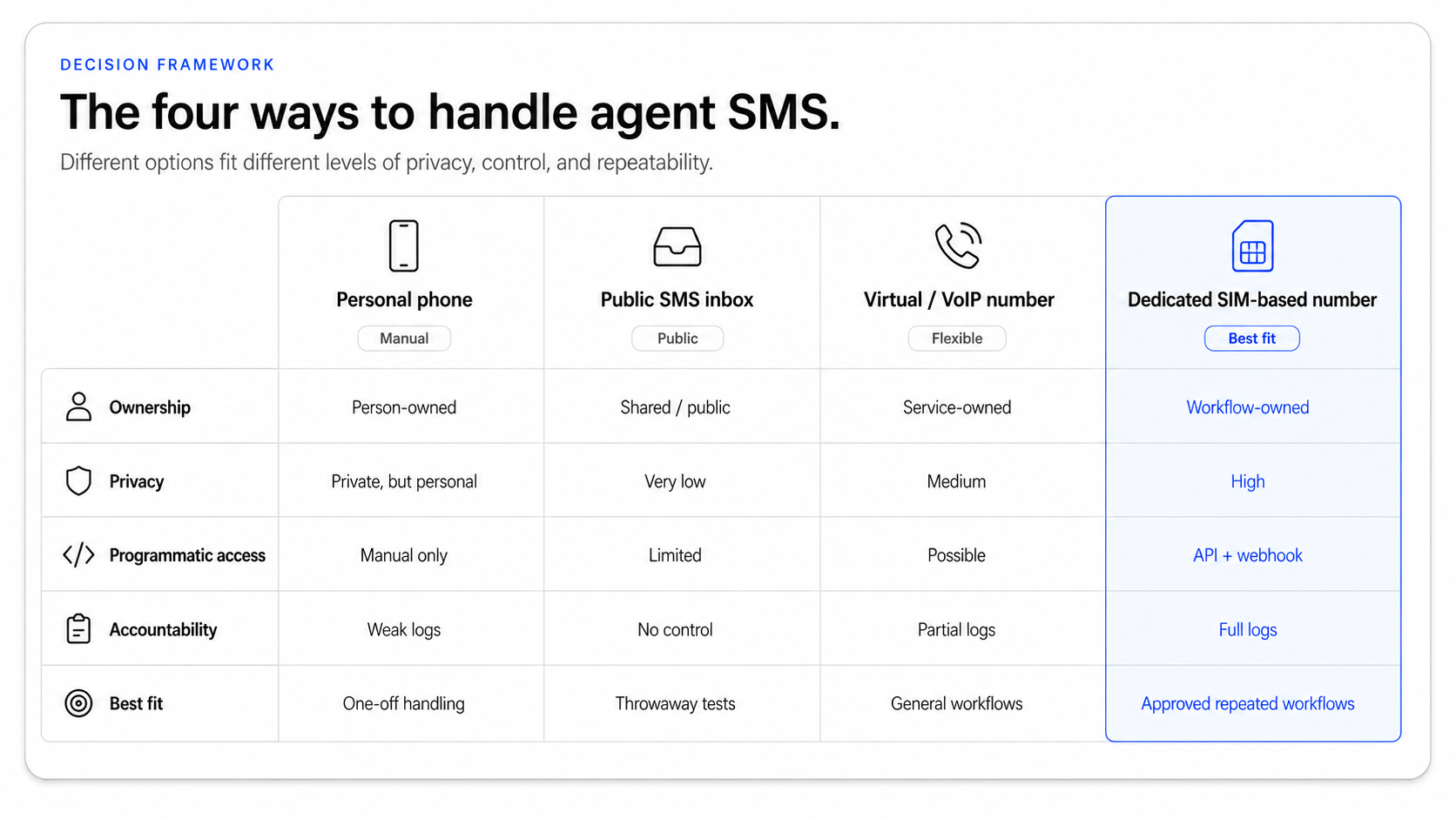
Each option has a different tradeoff. A personal phone is fast, but it exposes the person and creates a manual dependency. A public inbox is easy, but it is not private, owned, or suitable for accountable workflows; a large study of disposable phone numbers found that public SMS gateways are used both for privacy and for abuse, including fraudulent account creation and bypassing security mechanisms. A virtual/VoIP number can be useful, and existing providers already show that inbound SMS can be delivered programmatically through webhooks: Twilio documents incoming message webhooks for Twilio phone numbers, and Vonage documents inbound SMS delivery to webhook endpoints for Vonage virtual numbers. But for workflows where a real mobile/SIM-based endpoint matters, a virtual-number-only setup may still be the wrong fit.
When a SIM-based number is the right option
The decision framework is simple. If the workflow is temporary, low-risk, and manually supervised, a human phone may be enough. If the workflow is not private or important, a public inbox may technically work, but it should not be treated as serious infrastructure. If the workflow only needs generic programmable SMS, a virtual number may be enough. But if the workflow is legitimate, repeated, account-facing, privacy-sensitive, or needs a real mobile/SIM endpoint, the phone number should be dedicated to the agent, workflow, client, or test environment.
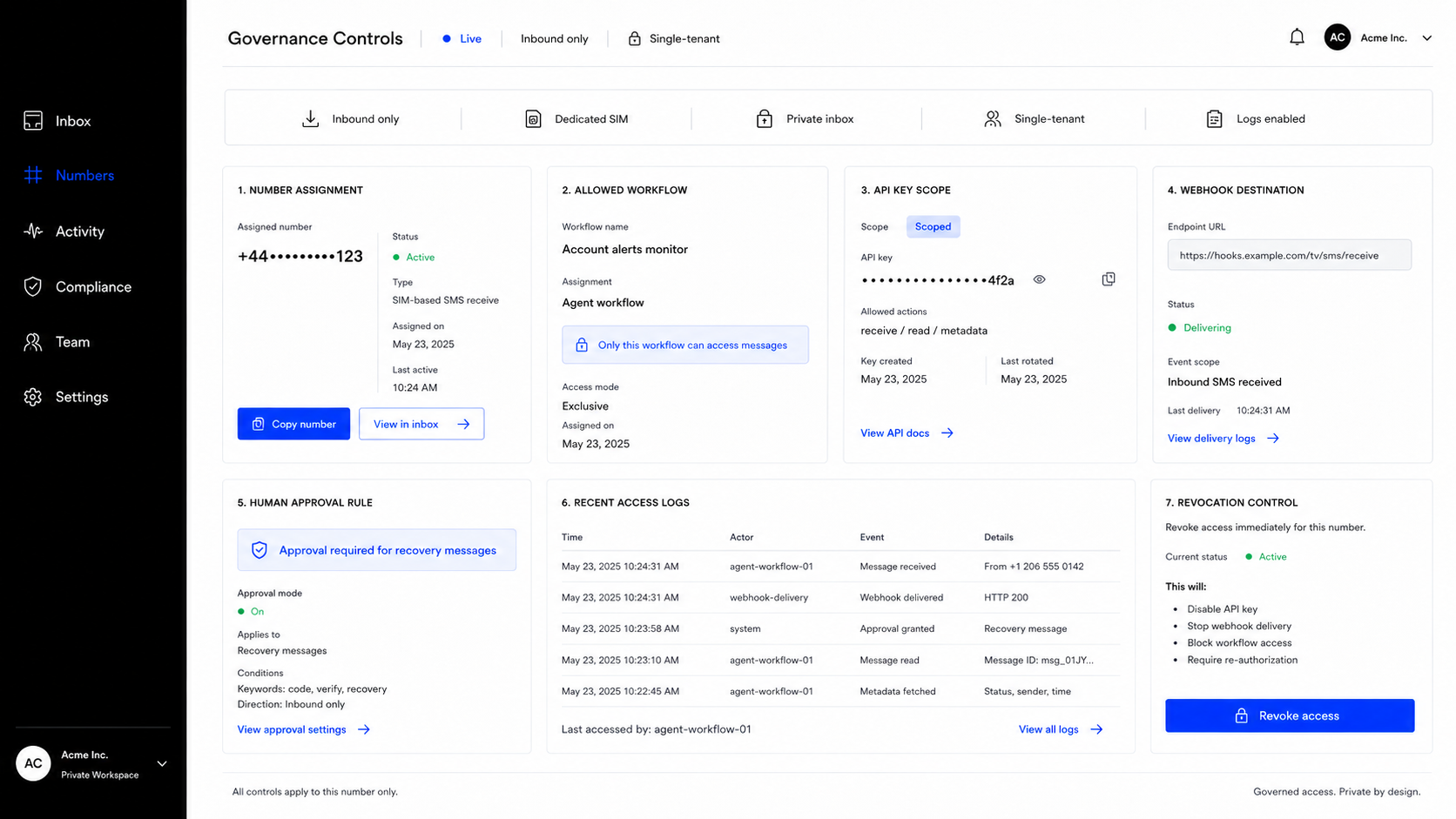
That is the approach Textrovault is built around. Give the agent or workflow its own SIM-based number. Receive SMS from that number through software. Let the operator view messages in a dashboard or route them through API/webhooks. Add access controls and logs so the number is not just reachable, but manageable.
The minimum serious setup
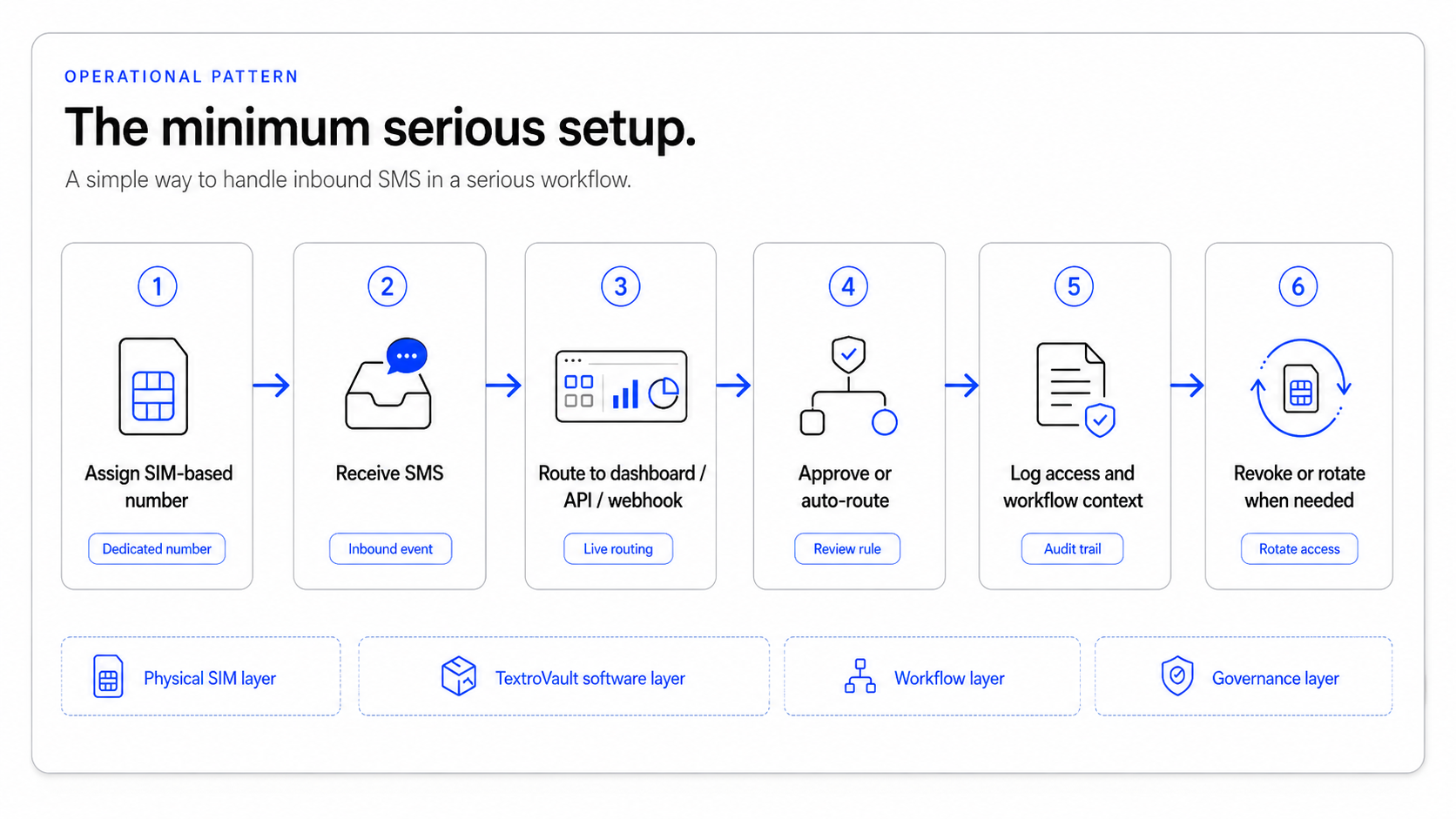
The useful artifact is the workflow itself: assign a SIM-based number to an agent or workflow; receive an SMS; expose the message through dashboard, API, or webhook; decide whether the agent can use it directly or whether a human must approve; log what happened. This is the minimum serious shape. It gives the agent the SMS capability it needs without turning a human phone into hidden infrastructure.
Authorized use is part of the product
This also explains why Textrovault treats authorized use as part of the product, not as a footnote. SMS is sensitive infrastructure. NIST treats PSTN-based out-of-band authentication as a restricted authenticator and tells verifiers to consider risks such as SIM changes, device swaps, number porting, and abnormal behavior. The lesson is not that SMS disappears from workflows. The lesson is that SMS access should be assigned, controlled, logged, and limited to workflows the operator is allowed to run.
The next action is intentionally narrow: if you are building an agent or automation that currently depends on a human phone number, identify one workflow where the phone number should belong to the agent, client, environment, or system instead. If that workflow needs a SIM-based number with dashboard access, API/webhooks, access controls, and logs, apply for early access to Textrovault.
EARLY ACCESS
If you are building an authorized agent or automation workflow that currently depends on a human phone number, apply for early access to Textrovault.
For operators using agents with accounts, systems, clients, test environments, or workflows they own, manage, or are explicitly allowed to operate.